 Resin MSLA~$344
Anycubic · released 2024
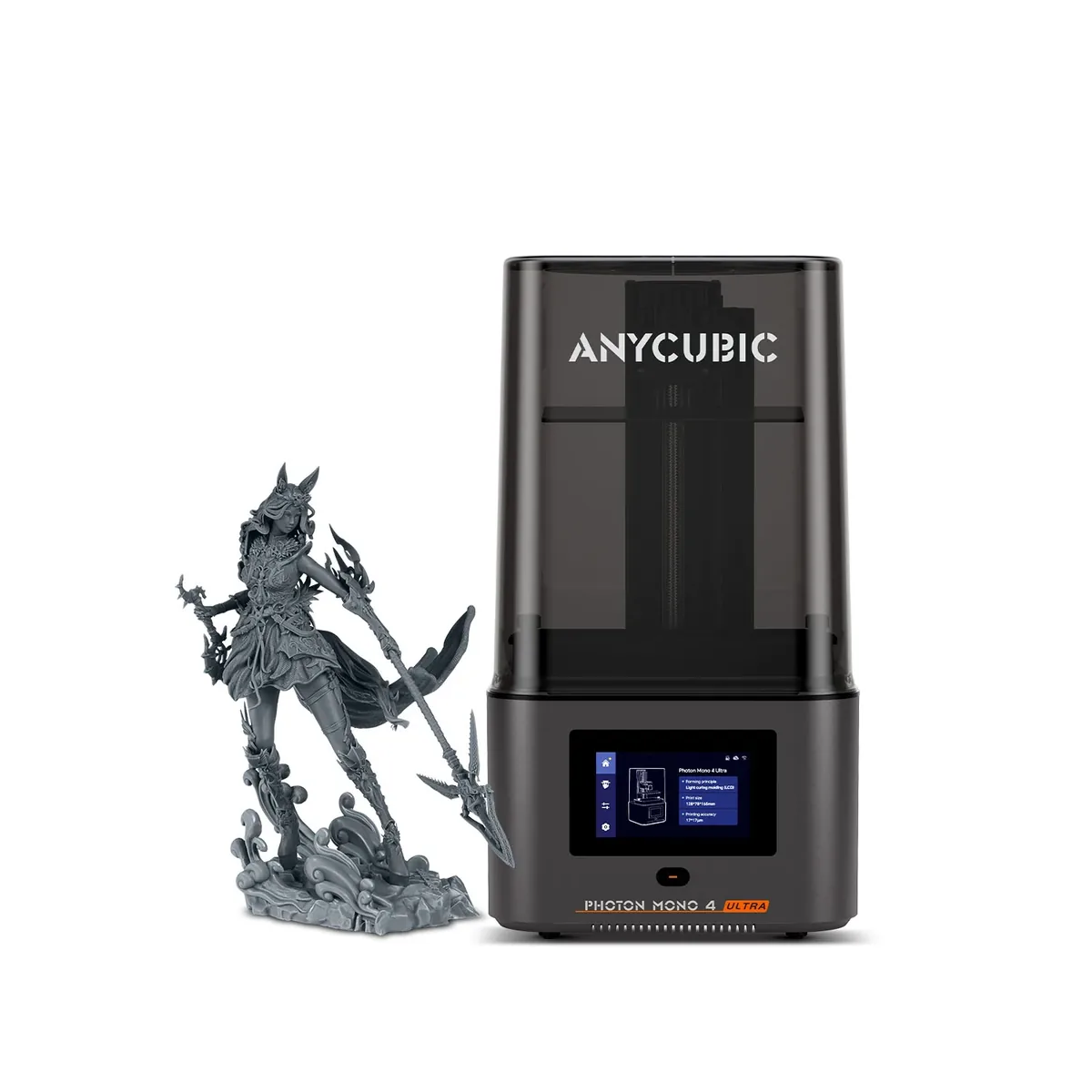
Anycubic Photon Mono 4 Ultra
Anycubic's direct answer to the Mars 5 Ultra, and it wins the specification comparison narrowly: a 17 µm pixel against 18, an 87 mm plate depth against 78, and the same ACF film. Seventeen microns over a 153 mm plate is genuinely fine detail, and ACF release keeps peel forces low enough that thin supports survive. Anycubic's LighTurbo optical stack is the part it markets hardest — a Fresnel-lens arrangement aimed at even light across the whole panel, which matters because uneven curing shows up as parts printing well in the middle of the plate and poorly at the edges. There is no camera, where Elegoo includes one at a lower price, and Anycubic's slicer is the less-liked of the two. The choice between these two machines comes down to ecosystem preference more than capability.
- Approx. price
- ~$344
- Build volume
- 2.2 L
- Per litre
- $156
- XY pixel
- 17 µm
Best forDetailed miniature work where pixel pitch is the deciding number.
Specifications
- Build volume
- 153.4 × 87 × 165 mm
- Volume
- 2.2 L
- Motion
- gantry
Optics and handling
- LCD resolution
- 9024 × 5120 px
- LCD size
- 7 in
- XY resolution
- 17 µm
- Layer height
- from 10 µm
- Release film
- ACF
- Vat capacity
- 350 ml
- Multi-material
- None offered
- Firmware
- proprietary
- Cloud
- Optional
- Camera
- No
- Assembly
- Pre-assembled
- Weight
- 7 kg
- Footprint
- 254 × 247 × 405 mm
Features
- 7-inch 9K panel, 9024 × 5120 — a 17 µm pixel
- ACF release film
- LighTurbo optical system for even illumination across the panel
- 153.4 × 87 × 165 mm plate
What it does well
- 17 µm pitch narrowly beats the Mars 5 Ultra's 18 µm, and both beat everything cheaper
- 87 mm plate depth gives more usable area than its closest rival's 78 mm
- ACF film keeps peel forces low, so fine supports survive the lift
- Optical stack is designed around even curing edge to edge, which is where cheap resin printers fall down
Where it gives ground
- No camera, where the cheaper Mars 5 Ultra includes one
- Anycubic's slicer and software are the weaker of the two ecosystems
- 350 ml vat is small for batch work
- No heated vat, so cold rooms slow it noticeably
The points above are read off published specifications, not from owner reports.
What owners report
Drawn from owner discussions in 3D-printing communities, not from our own testing — this site has no test lab.
What owners like
- Owners moving across from filament printing describe it as an approachable entry into resin, and it appears often on shortlists for occasional detailed work
- The 17 µm pixel is the finest in its price class and owners printing miniatures do get the detail they came for
- ACF release film is fitted as standard, which is a meaningful upgrade over the standard film at this price
- Frequently discounted, which is usually what tips people into trying resin for the first time
Common complaints
- Bed adhesion failing across only part of the plate — sticking at the back and not the front — appears in owner reports, associated with a lip where the screen is installed
- Punctured release film from resin curing onto it is a recurring beginner failure, and freeing the film without damaging the tank is fiddly
- Getting past calibration to a real print takes owners real effort, with external calibration test suites the standard recommendation
- No camera, where Elegoo's competing machine at a lower price includes one
- Anycubic's slicer and software are the less-liked half of the two-brand comparison owners keep making
The Photon Mono 4 Ultra is Anycubic's direct answer to Elegoo's Mars line and it wins on paper — a 17 µm pixel against 18, a deeper plate, the same ACF film. Owners coming to resin from filament printing describe it as an approachable place to start, particularly when it is discounted, which it often is.
The problems owners report are the classic resin-beginner ones plus one that appears specific to the machine: adhesion failing on only part of the plate, sticking reliably at the back and not at the front, which owners associate with a lip where the screen is mounted rather than with technique. Punctured release film, where resin has cured onto it and welded it to the tank, is the other frequently reported early disaster — it is a beginner error but a costly and messy one.
What owners consistently recommend is working through a structured exposure calibration suite rather than trusting the supplied profile, and that advice comes up often enough to treat as a required step rather than an optional refinement.
Questions owners ask
+Why do prints only stick to part of the plate?
Owners have reported adhesion working on the back half of the plate and failing on the front, and associate it with a lip where the screen is installed affecting how the plate seats. Re-levelling carefully and checking the plate sits flat is the first step; if it persists across a properly levelled plate, it is worth raising with the seller while a return is still possible.
+How do I avoid puncturing the release film?
Punctures happen when a failed print cures onto the film and is then pulled or scraped off. The preventive habits owners recommend are getting exposure right before attempting a real model, filtering resin between prints so cured fragments do not sit in the tank, and gently checking the vat for stuck pieces after any failure rather than immediately starting again.
+What calibration should I run first?
Owners consistently point newcomers at a structured exposure test suite rather than the supplied profile, particularly when using third-party resin. Every resin has its own exposure characteristics, and running the test once per resin is what separates people getting good prints from people posting failure photographs.
+Mono 4 Ultra or an Elegoo Mars 5 Ultra?
Specifications are very close — the Anycubic has a slightly finer pixel and a deeper plate; the Elegoo includes a camera at a lower price. Owner discussions tend to favour Elegoo's software, so the decision often comes down to ecosystem preference and whichever is discounted at the time.