 FDM multi-material~$1,899
Bambu Lab · released 2025
Bambu Lab H2D
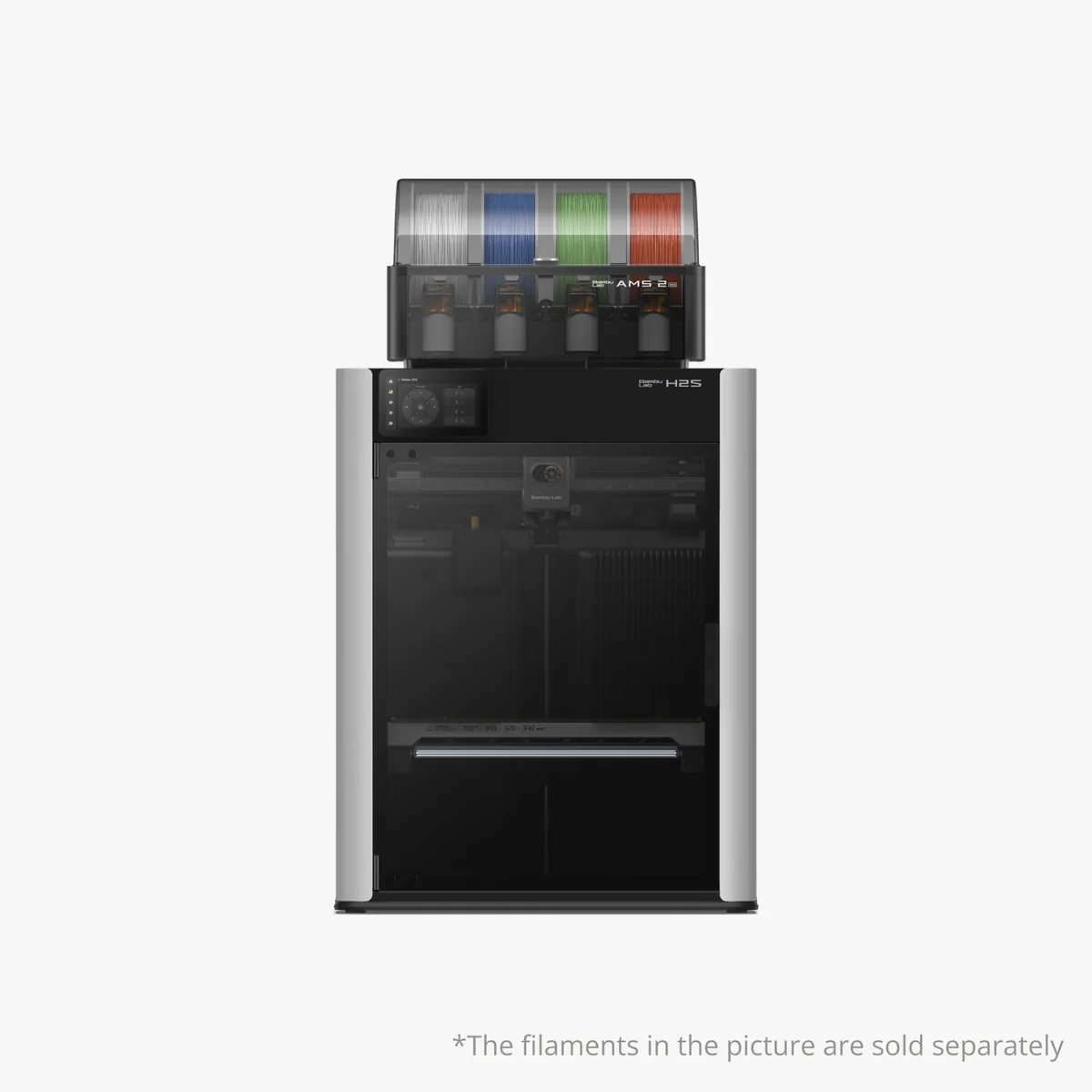
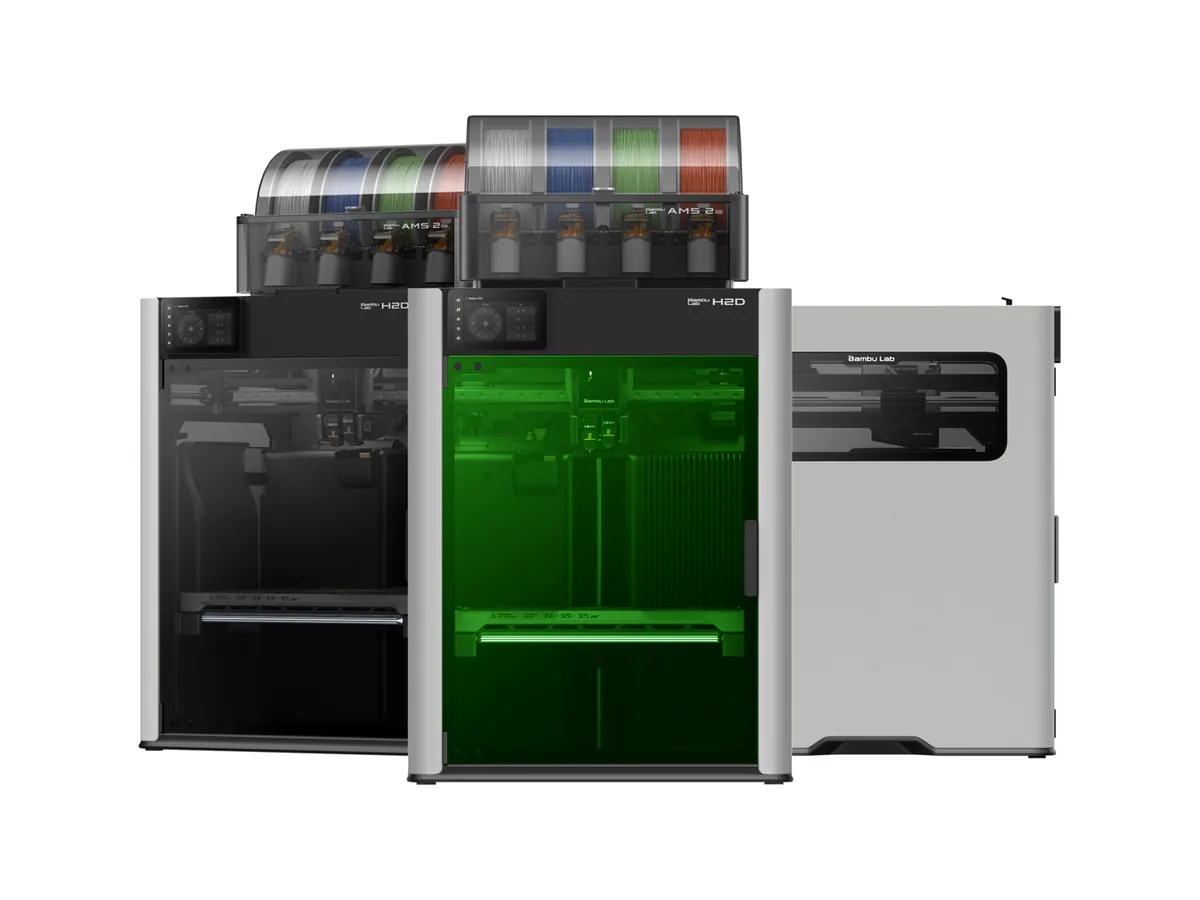
Two independently driven nozzles on one CoreXY gantry is what separates the H2D from everything below it, and the reason it matters is waste: a second nozzle carrying support or a second colour means no purge tower, which on a multi-colour print can be more plastic than the model itself. Build volume drops from 325 mm wide in single-nozzle mode to 300 mm when both are in play. It is also the one Bambu machine that publishes a volumetric flow figure — 40 mm³/s standard, 65 mm³/s with the optional very-high-flow hotend — which makes it the only member of the range whose speed claim can actually be checked. The chamber drives to 65 °C, the bed to 120 °C, the hotend to 350 °C, and laser and cutting modules turn it into a different class of machine again. At 31 kg with a half-metre footprint, it is furniture.
- Approx. price
- ~$1,899
- Build volume
- 33.8 L
- Per litre
- $56
- True multi-material price
- ~$2,199
Real speed ceiling
500 mm/s
40 mm³/s ÷ (0.4 mm × 0.2 mm) = 500 mm/s. The H2D is advertised at 1000 mm/s, so the hotend can feed 50% of the headline figure. An estimate for a straight line at the hotend’s rated flow — real prints are slower again.
Best forMulti-material and multi-colour work at size, where purge waste and chamber heat both matter.
Specifications
- Build volume
- 325 × 320 × 325 mm
- Volume
- 33.8 L
- Motion
- CoreXY
- Max speed
- 1000 mm/s
- Acceleration
- 20,000 mm/s²
- Max flow
- 40 mm³/s
- Hotend max temp
- 350 °C
- Bed max temp
- 120 °C
- Enclosure
- Heated chamber to 65 °C
- Extruder
- direct drive
- Auto level
- eddy-current
- Hardened nozzle
- Yes, as standard
Materials, control and build
- Multi-material
- AMS 2 Pro, 4 slots
- True multi-material price
- ~$2,199 (+~$300)
- Firmware
- Bambu
- Cloud
- Optional
- Camera
- Yes
- Assembly
- Pre-assembled
- Noise
- 54 dB
- Weight
- 31 kg
- Footprint
- 492 × 514 × 626 mm
Features
- Two independently driven nozzles — no purge tower for supports or second colours
- Published 40 mm³/s flow rate, or 65 mm³/s with the high-flow hotend
- Chamber heated to 65 °C, bed to 120 °C, hotend to 350 °C
- Three 1080p cameras including a macro nozzle view
- Optional 10 W and 40 W laser and cutting modules
- Hardened steel nozzles as standard, 0.2 to 0.8 mm supported
What it does well
- Dual nozzles cut the filament waste that makes multi-colour printing expensive on every single-nozzle machine here
- Publishes a real 40 mm³/s flow figure, so its throughput claim can be verified rather than trusted
- Driven 65 °C chamber, 350 °C hotend and 120 °C bed cover essentially the whole desktop materials list
- Laser and cutting modules make it a multi-process machine rather than only a printer
- Nozzle-level macro camera makes remote monitoring genuinely useful
Where it gives ground
- Build width drops from 325 mm to 300 mm as soon as you use the second nozzle
- 31 kg and 492 × 514 mm of bench — it cannot share a desk
- The H2S is larger and much cheaper if you do not need the second nozzle
- Laser modules push the total well past $2,500 and bring their own ventilation requirements
- AMS 2 Pro still costs extra on a machine at this price
The points above are read off published specifications, not from owner reports.
What owners report
Drawn from owner discussions in 3D-printing communities, not from our own testing — this site has no test lab.
What owners like
- Dual nozzles solve the waste problem that owners cite most when planning support-heavy or multi-material work — no purge tower for supports
- It is the only Bambu machine that publishes a volumetric flow figure, so its speed claim can actually be checked
- The chamber, hotend and bed temperatures together cover essentially the entire desktop materials list, which owners buying for functional work specifically weigh
- Interesting enough as a design that the community has begun reverse-engineering an open-source equivalent of its dual-nozzle toolhead
- Owners evaluating it for small-business functional printing take it seriously against much more expensive alternatives
Common complaints
- Owner accounts of arriving damaged exist, including one describing thousands of dollars of broken parts on a first Bambu purchase
- Owners explicitly caution each other against trusting promotional videos for this machine, preferring independent reviews
- Using the second nozzle costs 25 mm of build width, so the headline volume and the multi-material volume are different numbers
- At 31 kg with a half-metre footprint it needs dedicated space rather than a desk corner
- The single-nozzle H2S is larger and substantially cheaper, which makes the dual nozzle's value the entire question
The H2D is the machine owner discussions reach for when the question is waste rather than speed. A second nozzle carrying support material means no purge tower, and people planning support-heavy functional work — test fixtures, PCB holders, automotive parts — raise it specifically for that. It is also the only printer in Bambu's range that publishes a volumetric flow rate, which makes it the only one whose throughput claim can be verified rather than trusted.
It attracts scrutiny to match its price. Owners caution each other against taking promotional material at face value and point toward independent reviews instead, and comparisons against the established toolchanger alternative are a running thread. At least one detailed account describes a first Bambu purchase arriving as thousands of dollars of broken parts, which is a reminder that shipping a 31 kg machine is its own risk.
The most useful thing to understand before buying is what the second nozzle costs: build width drops from 325 mm to 300 mm as soon as both are in use. The single-nozzle H2S is both larger and considerably cheaper, so the dual nozzle needs to be the reason you are buying.
Questions owners ask
+H2D or H2S?
The H2S is larger — a single nozzle sweeps the full bed width — and substantially cheaper. The H2D's only advantage is the second nozzle, which removes purge waste for supports and second materials. If you do not need that, owners are fairly direct that the H2S is the better buy.
+Does the second nozzle reduce the build volume?
Yes. Build width drops from 325 mm in single-nozzle mode to 300 mm when both nozzles are in play, because the second head needs somewhere to be. It is a modest reduction but worth knowing when planning a part that is close to the limit.
+How much filament does the dual nozzle actually save?
On support-heavy prints and multi-colour work, a great deal — every colour or material change on a single-nozzle machine flushes the whole hot end, and on a large print that discarded plastic can exceed the model's own weight. This is the specific problem owners buying it are trying to solve.
+H2D or a Prusa XL?
A frequently debated comparison. The XL has five independent toolheads and a larger build volume; the H2D has two nozzles, a heated chamber and costs far less. Owners point each other toward independent reviews on this one rather than manufacturer material, and the answer depends heavily on whether two materials is enough for your work.