 Large-format FDM~$1,249
Bambu Lab · released 2025
Bambu Lab H2S
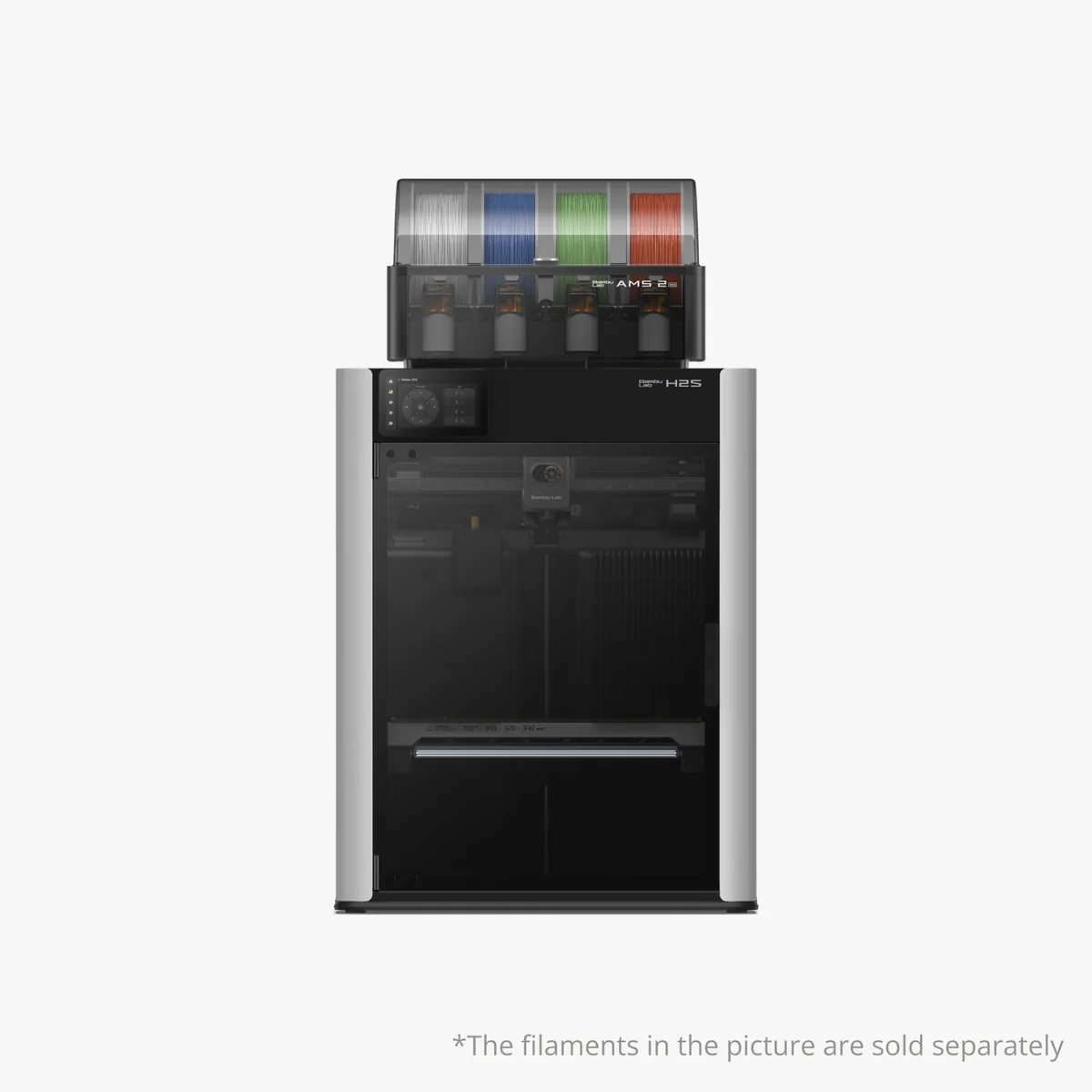
The H2S is an H2D with the dual-nozzle head removed, and that subtraction turns out to be the point: a single nozzle sweeps the full 340 mm width instead of giving up 25 mm to its twin, so this is the largest build area Bambu sells. Everything else in the H-series second-generation package is intact — servo extruder, 65 °C driven chamber, 350 °C hotend, 120 °C bed, AI monitoring along the filament path. For anyone whose reason to want an H2D was size and materials rather than dual-material printing, this is several hundred dollars cheaper for a bigger box. The trade is real, though: without the second nozzle, soluble supports and clean multi-material interfaces go back to costing a purge tower. At 30 kg and half a metre deep it needs a dedicated surface, not a corner of a desk.
- Approx. price
- ~$1,249
- Build volume
- 37.0 L
- Per litre
- $34
- True multi-material price
- ~$1,499
Real speed ceiling
Not published
Bambu Lab does not publish a volumetric flow rate for the H2S, so its 1000 mm/s claim cannot be checked against what the hotend can actually melt. We do not estimate one.
Best forLarge engineering-material parts where you want size and chamber heat but not dual-nozzle printing.
Specifications
- Build volume
- 340 × 320 × 340 mm
- Volume
- 37.0 L
- Motion
- CoreXY
- Max speed
- 1000 mm/s
- Acceleration
- 20,000 mm/s²
- Max flow
- Not published
- Hotend max temp
- 350 °C
- Bed max temp
- 120 °C
- Enclosure
- Heated chamber to 65 °C
- Extruder
- direct drive
- Auto level
- eddy-current
- Hardened nozzle
- Yes, as standard
Materials, control and build
- Multi-material
- AMS 2 Pro, 4 slots
- True multi-material price
- ~$1,499 (+~$250)
- Firmware
- Bambu
- Cloud
- Optional
- Camera
- Yes
- Assembly
- Pre-assembled
- Noise
- 54 dB
- Weight
- 30 kg
- Footprint
- 492 × 514 × 626 mm
Features
- 340 × 320 × 340 mm — the largest build area Bambu sells
- Chamber actively heated to 65 °C
- 350 °C hotend, 120 °C bed, hardened nozzle as standard
- Servo extruder with AI monitoring along the whole filament path
- AMS 2 Pro support with in-unit drying
What it does well
- Single nozzle uses the full bed width, giving more usable area than the pricier H2D
- Driven 65 °C chamber with a 350 °C hotend makes ABS, ASA, PC and nylon genuinely practical at size
- Second-generation servo extruder and flow sensing carried over intact from the H2D
- Several hundred dollars cheaper than the dual-nozzle machine it is based on
- Still runs LAN-only without a cloud account
Where it gives ground
- No second nozzle, so soluble supports and clean colour changes cost a purge tower again
- 30 kg and a 492 × 514 mm footprint — this needs its own bench
- No published volumetric flow figure to justify the 1,000 mm/s toolhead claim
- Expensive next to the X2D, which has the same chamber temperature in a smaller box
- AMS 2 Pro is extra on top of an already high price
The points above are read off published specifications, not from owner reports.
What owners report
Drawn from owner discussions in 3D-printing communities, not from our own testing — this site has no test lab.
What owners like
- Owners with thousands of hours on a passive-enclosure P1S cite the driven chamber as precisely what they were missing for ABS work
- The single nozzle using the full bed width is the specific reason owners choose it over the dual-nozzle model — more space for less money
- In markets with heavy import duties, it lands as the large heated-chamber option when the dual-nozzle machines are simply out of reach
- Carries the whole second-generation package — servo extruder, flow sensing, filament-path monitoring — with nothing removed except the second nozzle
- Owners moving up from long-serving cheaper machines describe it as a substantial step rather than an incremental one
Common complaints
- Owners actively worry about buying a single-nozzle machine as multi-nozzle designs proliferate, which is a real timing concern rather than a defect
- Fume handling generates genuine confusion — owners disagree about whether the included charcoal filter is sufficient, with some reporting they can still smell VOCs and no consensus on what to do about it
- Owners have bought one and then watched a competing large machine launch shortly after, which is the hazard of a fast-moving category
- Expensive next to the X2D, which offers the same chamber temperature in a smaller box for far less
- It is large and heavy enough to need dedicated space rather than a desk
The H2S exists because plenty of buyers wanted the H-series' size and heated chamber and had no use for a second nozzle. Owner discussions bear that out: people with thousands of hours on a passive-enclosure P1S describe the driven chamber as the thing that was missing, and the single nozzle sweeping the full bed width means this is actually the larger machine of the two.
The most interesting recurring thread about it is not about printing at all. Owners argue about fume handling — whether the included activated-carbon filter is adequate, whether people can still smell VOCs through it, and whether venting out of a window is necessary — and reach no consensus. Given that the whole point of this machine is materials like ABS and ASA that emit more than PLA, that is a question worth resolving for yourself before buying rather than after.
The other hesitation owners voice is timing. With multi-nozzle machines multiplying, some worry about buying a single-nozzle printer now, and at least one owner bought an H2S shortly before a competing large machine launched. That is the standing hazard of this category rather than a criticism of the printer.
Questions owners ask
+H2S or H2D?
The H2S has a larger usable build area because one nozzle uses the full bed width, and it costs substantially less. The H2D's dual nozzle removes purge waste for supports and second materials. Owners are fairly direct: if you do not specifically need the second nozzle, the H2S is more machine for less money.
+Is the charcoal filter enough for ABS fumes?
Owners disagree, and the disagreement is unresolved. Some argue the included filter is sufficient; others report still smelling VOCs and advocate venting out of a window. Activated carbon adsorbs VOCs but does comparatively little for ultrafine particles, so if the printer will share a room you occupy, plan for extraction rather than relying on the filter alone.
+Is it worth buying a single-nozzle machine now?
Owners raise this exact worry. The honest position is that single-nozzle machines remain the large majority of the market and will be supported for years, and that a second nozzle mainly buys reduced purge waste on multi-material work. If you print one material at a time, it is not a capability you are missing.
+H2S or a Prusa CORE One?
A frequent comparison. The H2S is much larger with a hotter chamber; the CORE One is open, serviceable, quieter and smaller. Owners who already have a Bambu and are buying a second printer often ask this precisely because they want a different set of trade-offs the second time around.