 Large-format FDM~$469
Bambu Lab · released 2026
Bambu Lab A2L
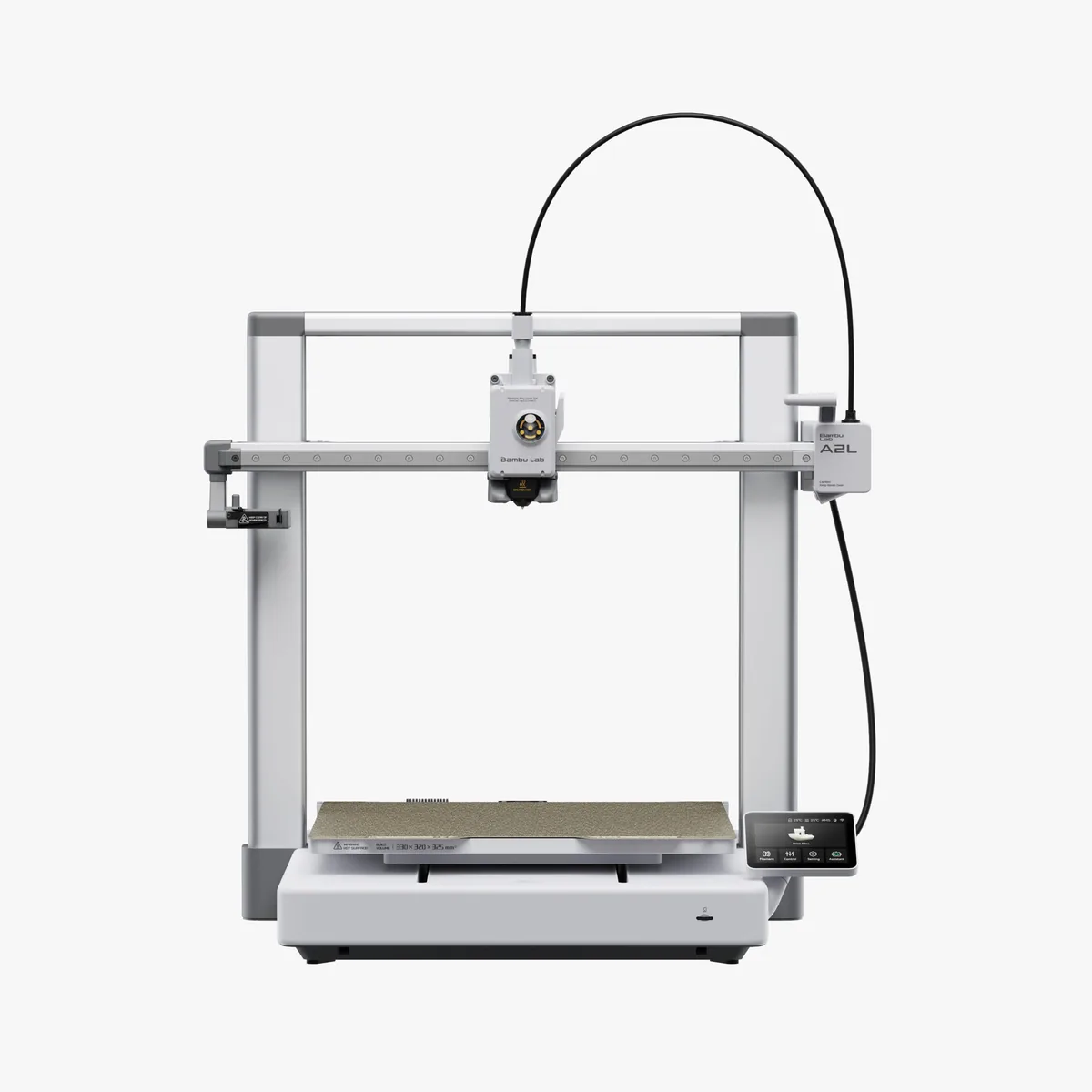
Bambu's answer to the question its own customers kept asking — where is the big cheap one — arrived in June 2026 as an open-frame bed-slinger with an H-series-sized build area for about a third of H-series money. At 330 × 320 × 325 mm it is roughly twice the volume of an A1, and it borrows the 1.5 mm-pitch belts from the H machines rather than the A1's lighter hardware. The compromises are where you would expect them: the bed still tops out at 80 °C and there is still no enclosure, so this is a large PLA and PETG machine rather than a large engineering-materials machine. A filament cutter is built into the toolhead, which matters because AMS lite colour changes on a bed this size would otherwise waste an unreasonable amount of plastic. Reviewers have framed it as an H2S Lite, which is fair on volume and misleading on materials.
- Approx. price
- ~$469
- Build volume
- 34.3 L
- Per litre
- $14
- True multi-material price
- ~$569
Real speed ceiling
Not published
Bambu Lab does not publish a volumetric flow rate for the A2L, so its 500 mm/s claim cannot be checked against what the hotend can actually melt. We do not estimate one.
Best forPrinting big PLA and PETG parts in one piece without paying for an enclosed machine.
Specifications
- Build volume
- 330 × 320 × 325 mm
- Volume
- 34.3 L
- Motion
- bedslinger
- Max speed
- 500 mm/s
- Acceleration
- 10,000 mm/s²
- Max flow
- Not published
- Hotend max temp
- 300 °C
- Bed max temp
- 80 °C
- Enclosure
- Open frame
- Extruder
- direct drive
- Auto level
- strain-gauge
Materials, control and build
- Multi-material
- AMS lite, 4 slots
- True multi-material price
- ~$569 (+~$100)
- Firmware
- Bambu
- Cloud
- Optional
- Camera
- Yes
- Assembly
- Pre-assembled
- Noise
- 49 dB
Features
- 330 × 320 × 325 mm build area — about twice an A1's
- 1.5 mm-pitch belts shared with the H-series
- Toolhead filament cutter to trim AMS lite purge
- Chains AMS lite units for up to 19 colours
- Quoted at around 49 dB in silent mode
What it does well
- Enormous build area for the money — cosplay and prop parts that used to need slicing fit whole
- Belt and motion hardware come from the H-series rather than the budget A-series parts bin
- Built-in filament cutter meaningfully reduces the purge penalty on multi-colour prints
- Keeps the A-series setup experience: calibrated, quiet, no tramming
Where it gives ground
- 80 °C bed and no enclosure mean a large machine that still cannot print ABS, ASA or nylon
- A bed this big slinging in Y is the hardest case for ringing on tall prints
- No published flow rate, so nothing about throughput on large parts can be verified from the spec sheet
- Too new for long-run reliability or spare-part availability to be known
- Needs a lot of desk depth for the bed to travel
The points above are read off published specifications, not from owner reports.
What owners report
Drawn from owner discussions in 3D-printing communities, not from our own testing — this site has no test lab.
What owners like
- Shipping has beaten its own backorder estimates — at least one owner reports ordering on a Monday and receiving it that Friday against a two-week expectation
- The build volume for the money is the draw, and it is the reason it appears on first-printer shortlists against much pricier machines
- It inherits the A-series ownership experience — calibrated, quiet, no tramming — at a size the A-series previously did not reach
- Belt and motion hardware come from the larger H-series rather than the budget parts bin, which owners analysing the leaks noted approvingly
Common complaints
- Community analysis was sceptical of the marketing before launch, with a widely read post arguing it is simply a very large bed-slinger rather than the new category the teaser implied
- It is an open frame with an 80 °C bed, so this is a large PLA and PETG machine and not a large engineering-materials machine
- Buyers comparing it against the X2D end up weighing raw size against a heated chamber and a second nozzle, and the answer depends entirely on materials
- Too new for long-run reliability or spare-part availability to be known
- A bed this large moving in Y is the hardest geometry to print tall parts on quickly, whatever the speed rating says
The A2L is Bambu answering the complaint it heard most: that its affordable machines were small and its large machines were expensive. Owner discussion of it began sceptically — a widely read pre-launch post argued that the teaser's framing oversold what the leaks showed, and that this was fundamentally a very large bed-slinger. That assessment turned out to be accurate, and it is not necessarily a criticism: a very large bed-slinger at this price is a thing plenty of people want.
What owners are actually weighing it against is the X2D, and the comparison is clean. The A2L gives you roughly twice the space; the X2D gives you a heated chamber and a second nozzle in a smaller box. If your list is PLA, PETG and TPU, the A2L's size wins easily. If it includes ABS, ASA or nylon, the open frame and 80 °C bed rule it out and the choice is made for you.
On the practical side, deliveries have run ahead of the quoted backorder times, which at least one owner found inconvenient in a very specific way involving hiding a large parcel from a partner.
Questions owners ask
+A2L or X2D?
This is the decision most first-time buyers in this bracket are making. The A2L has roughly twice the build volume; the X2D has an actively heated chamber, a 350 °C hotend and a second nozzle for supports. For PLA, PETG and TPU, size wins. For ABS, ASA or nylon, the A2L is not the machine — its bed tops out at 80 °C and there is no enclosure.
+Is the A2L just a big A1?
Broadly yes, and community analysis said so before launch. It is a bed-slinger with roughly twice the build area, using belts from the larger H-series, plus a toolhead filament cutter to reduce multi-colour purge. That is a fair description rather than a criticism — a big cheap bed-slinger is a real gap in the market.
+Can it print ABS?
No, not practically. An 80 °C bed and an open frame mean large parts in ABS or ASA will warp and lift. The larger the part, the worse it gets, which is unfortunate on a machine whose whole purpose is large parts.
+How fast is it really on tall prints?
Slower than the number suggests. A 330 mm bed carrying a part back and forth in Y has a great deal of inertia to reverse on every layer, and that gets worse as the print gets taller and heavier. CoreXY machines do not have this problem — which is part of what the extra money buys elsewhere.