 FDM enclosed~$549
Bambu Lab · released 2025
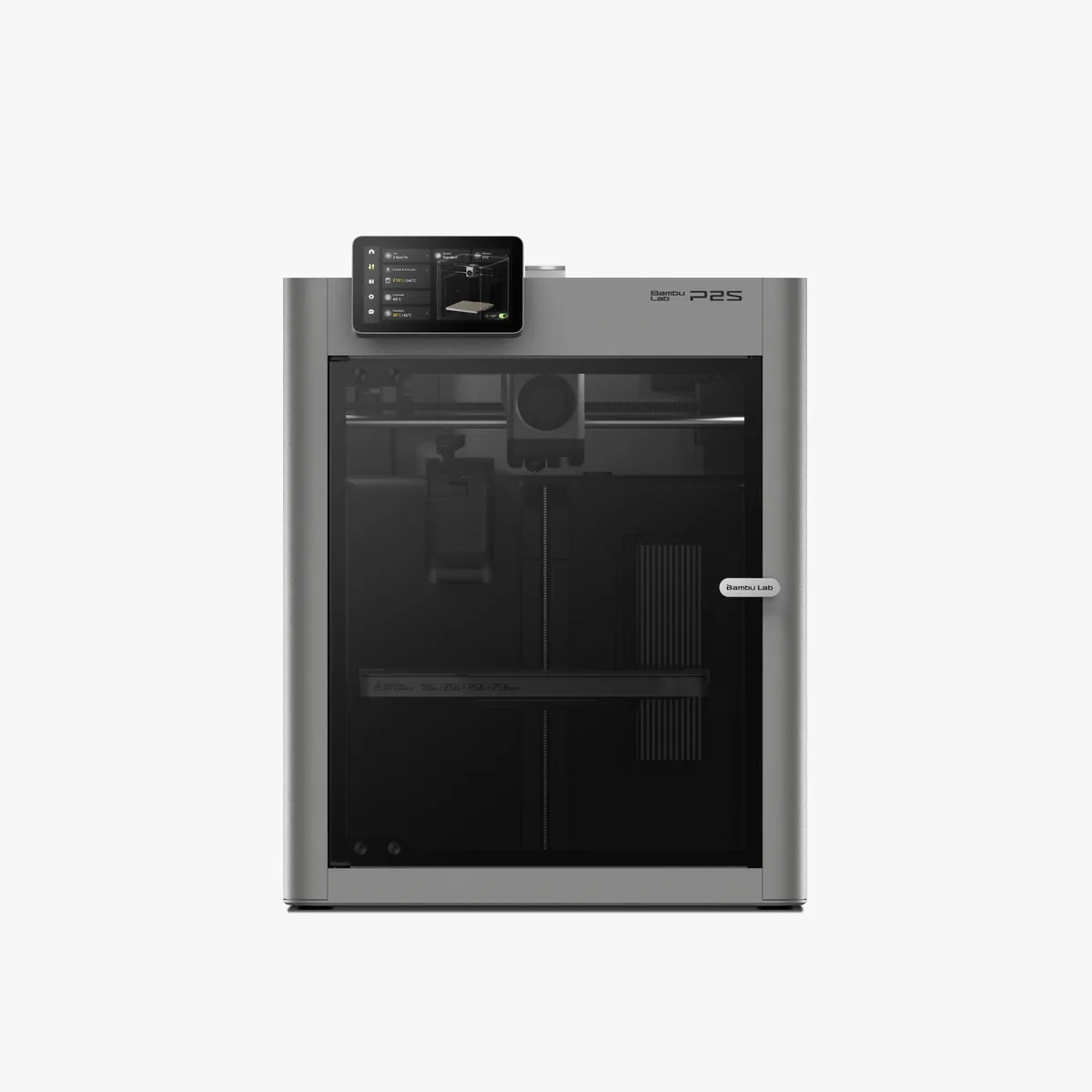
Bambu Lab P2S
What the P2S changes over the P1S is almost entirely in the toolhead. The stepper that pushed filament has been replaced by a permanent-magnet servo — Bambu calls it DynaSense — with roughly 70% more extrusion force, and an eddy-current sensor now measures flow as it happens and corrects for it mid-print. That is a different engineering answer to fast printing than simply raising the speed ceiling: instead of asking the user to tune max volumetric speed per filament, the printer measures what is actually coming out. Build volume is unchanged at 256 mm, the enclosure is still passive, and the frame is the familiar P-series cube. Tom's Hardware gave it the first Editor's Choice ever awarded to a P-series machine. The AMS 2 Pro that pairs with it dries filament in the unit, which is the fix for the humidity problems that dog long multi-colour prints.
- Approx. price
- ~$549
- Build volume
- 16.8 L
- Per litre
- $33
- True multi-material price
- ~$799
Real speed ceiling
Not published
Bambu Lab does not publish a volumetric flow rate for the P2S, so its 600 mm/s claim cannot be checked against what the hotend can actually melt. We do not estimate one.
Best forSomeone who wants the P-series formula with the extrusion problems engineered out.
Specifications
- Build volume
- 256 × 256 × 256 mm
- Volume
- 16.8 L
- Motion
- CoreXY
- Max speed
- 600 mm/s
- Acceleration
- 20,000 mm/s²
- Max flow
- Not published
- Hotend max temp
- 300 °C
- Bed max temp
- 100 °C
- Enclosure
- Enclosed, unheated chamber
- Extruder
- direct drive
- Auto level
- eddy-current
- Hardened nozzle
- Yes, as standard
Materials, control and build
- Multi-material
- AMS 2 Pro, 4 slots
- True multi-material price
- ~$799 (+~$250)
- Firmware
- Bambu
- Cloud
- Optional
- Camera
- Yes
- Assembly
- Pre-assembled
- Noise
- 52 dB
- Weight
- 14.2 kg
- Footprint
- 389 × 389 × 457 mm
Features
- PMSM servo extruder with roughly 70% more force than the P1S stepper
- Eddy-current flow sensing that corrects extrusion in real time
- Enclosed 256 mm cube, CoreXY, hardened nozzle as standard
- Pairs with AMS 2 Pro, which actively dries filament in the unit
- 600 mm/s claimed toolhead speed at 20,000 mm/s²
What it does well
- Real-time flow compensation removes most of the per-filament tuning that fast printing used to require
- Servo extruder grips filament far better, which shows up as fewer failed long prints on soft and filled materials
- AMS 2 Pro's active drying addresses the single most common multi-colour failure cause
- Keeps LAN-only operation and the mature P-series accessory ecosystem
- Same footprint as a P1S, so existing enclosures and shelving still fit
Where it gives ground
- Build volume is identical to a P1S that now costs $150 less
- Chamber is still passive — this is not the machine for large ABS or polycarbonate
- Bambu still publishes no volumetric flow number, despite flow being the headline feature
- AMS 2 Pro is a meaningful extra cost over the older AMS
The points above are read off published specifications, not from owner reports.
What owners report
Drawn from owner discussions in 3D-printing communities, not from our own testing — this site has no test lab.
What owners like
- Owners upgrading from a P1S describe the extrusion improvements as the real difference, particularly on materials that used to need per-filament tuning
- It inherits the P-series ecosystem intact — the same footprint, the same accessories, the same enormous body of profiles and printed mods
- Small quality-of-life touches get noticed: owners have found the start-up chime is customisable and swap it for whatever they like
- Quieter than the P1S it replaces, which matters given how consistently noise is the P-series' recurring complaint
- Pairs with the AMS 2 Pro, whose in-unit drying addresses the commonest cause of failed long multi-colour prints
Common complaints
- Early-ownership extruder faults appear in owner reports — errors that the extruder cannot dispense filament normally, within the first fortnight
- Periodic banding on bottom layers shows up as an unexplained complaint
- Build volume is unchanged from a P1S that now costs significantly less, so the premium buys extrusion quality rather than capability
- The chamber is still passive, so it is not the answer for anyone whose reason to upgrade was large ABS parts
- No published flow rate, despite flow sensing being the headline feature
The P2S is a refresh rather than a new machine, and owner discussion treats it that way. The frame, the enclosure and the 256 mm build volume are all the P1S's; what changed is the toolhead, where a servo extruder and real-time flow sensing replace a stepper and a set of assumptions. Owners upgrading describe that as the genuine difference, showing up most on demanding and filled materials that previously needed tuning per spool.
Early reliability reports are not spotless. Errors reporting that the extruder cannot dispense filament normally appear within owners' first two weeks, and unexplained periodic banding on bottom layers shows up too. Neither seems widespread, but both are worth knowing on a machine whose selling point is extrusion consistency.
The strategic question owners keep asking is whether to buy this or the older P1S, which is now considerably cheaper for the same volume and enclosure. If you mostly print PLA and PETG, the gap in outcome is much smaller than the gap in price.
Questions owners ask
+P2S or the cheaper P1S?
Same build volume, same enclosure, same footprint. The P2S adds a servo extruder with real-time flow compensation, which mainly helps on filled and demanding materials by removing per-filament tuning. For PLA and PETG the difference is modest and the price gap is not — owners regularly point newcomers at the P1S for that reason.
+Does the P2S fix the P1S's noise problem?
Owners report it being quieter, which matters because noise is the single most persistent complaint about the P-series. It is still an enclosed machine with fans, so if it will live in a bedroom, treat it as improved rather than solved.
+Can it print ABS properly?
Better than an open-frame machine, but the chamber is passive rather than heated — it traps heat rather than driving it to a set temperature. Large ABS parts still warp. Owners whose reason to upgrade is engineering materials are generally pointed toward a machine with a driven chamber instead.
+What early problems should I watch for?
Owners have reported extruder errors — the printer reporting it cannot dispense filament normally — within the first couple of weeks, and some unexplained banding on bottom layers. If either appears on a new machine, it is worth raising while the return window is open rather than trying to tune around it.