 FDM enclosed~$399
Bambu Lab · released 2023
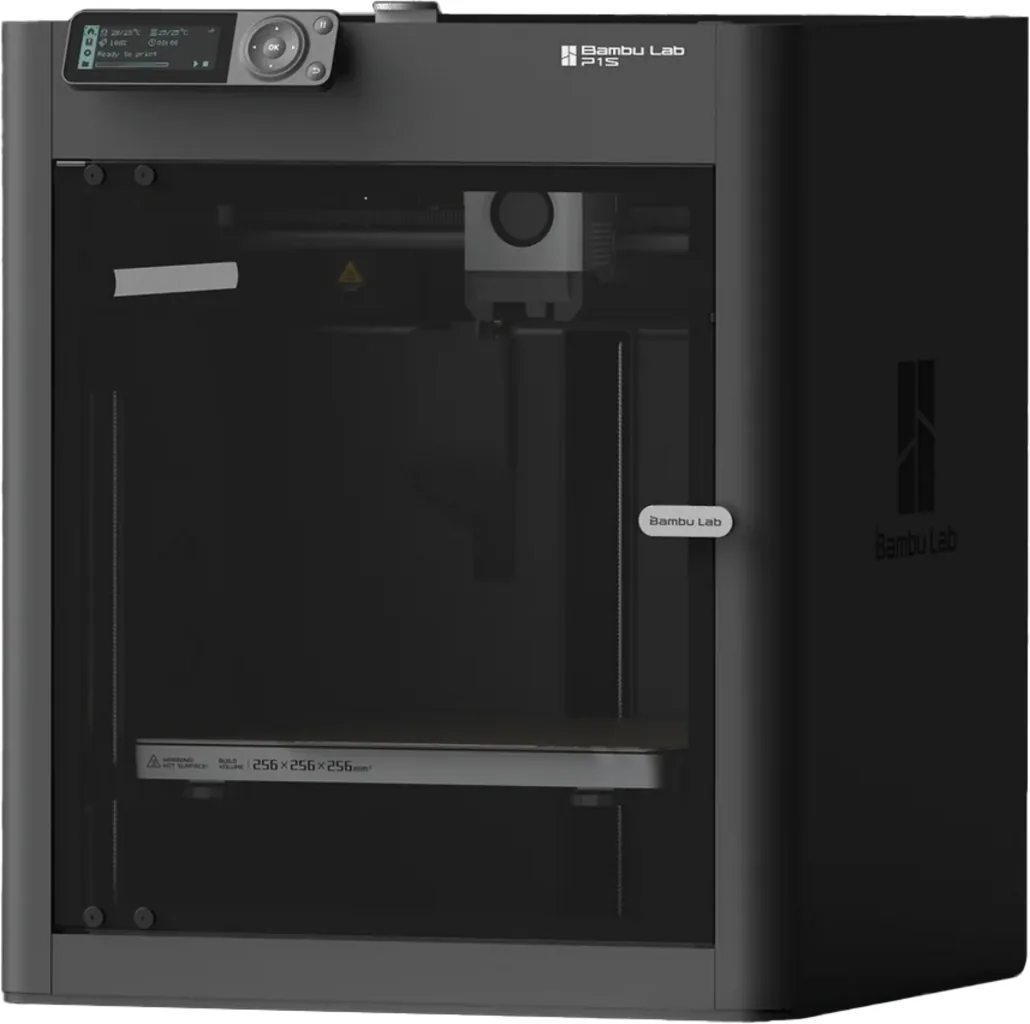
Bambu Lab P1S
For three years this was the machine everything else in the category got measured against: an enclosed CoreXY cube with a hardened nozzle, a camera, and an AMS ecosystem, at a price that repeatedly undercut printers with worse specs. The P2S has since taken over as the current P-series model and pushed the P1S down the range rather than out of it, which is why it now sits at $399 — arguably the best value in this catalogue. The enclosure is passive, not heated, so ABS and ASA work because the chamber holds warmth rather than because anything is driving it; large ABS parts still lift at the corners. The 256 mm cube is the same as the A1's, so the money buys the enclosure, the CoreXY motion and the hardened nozzle rather than more room. Bambu publishes no volumetric flow figure for it, which is the single biggest gap in comparing it against the Qidi and Elegoo machines that do.
- Approx. price
- ~$399
- Build volume
- 16.8 L
- Per litre
- $24
- True multi-material price
- ~$639
Real speed ceiling
Not published
Bambu Lab does not publish a volumetric flow rate for the P1S, so its 500 mm/s claim cannot be checked against what the hotend can actually melt. We do not estimate one.
Best forA first enclosed printer, or a second machine to run abrasive and higher-temperature filament.
Specifications
- Build volume
- 256 × 256 × 256 mm
- Volume
- 16.8 L
- Motion
- CoreXY
- Max speed
- 500 mm/s
- Acceleration
- 20,000 mm/s²
- Max flow
- Not published
- Hotend max temp
- 300 °C
- Bed max temp
- 100 °C
- Enclosure
- Enclosed, unheated chamber
- Extruder
- direct drive
- Auto level
- strain-gauge
- Hardened nozzle
- Yes, as standard
Materials, control and build
- Multi-material
- AMS, 4 slots
- True multi-material price
- ~$639 (+~$240)
- Firmware
- Bambu
- Cloud
- Optional
- Camera
- Yes
- Assembly
- Pre-assembled
- Noise
- 55 dB
- Weight
- 12.95 kg
- Footprint
- 389 × 389 × 457 mm
Features
- Enclosed 256 mm cube with CoreXY motion
- Hardened steel nozzle fitted as standard
- AMS support, chainable to four units for 16 colours
- Passive heat-retaining enclosure with an activated-carbon filter option
- 720p chamber camera with spaghetti detection
- LAN-only operation with no cloud account required
What it does well
- At $399 it is the cheapest enclosed CoreXY machine here that takes the AMS ecosystem
- Passive enclosure plus a 100 °C bed makes ASA and ABS workable for small and medium parts
- Mature platform: three years of profiles, spares, mods and documentation exist for it
- AMS integration is the most developed multi-material system in this catalogue
- Runs on a local network with no cloud account required
Where it gives ground
- Chamber is unheated, so big ABS parts still warp and delaminate at the corners
- 256 mm cube is unchanged from the far cheaper A1 — you are paying for the box, not the space
- No published volumetric flow rate to check the 500 mm/s claim against
- Superseded by the P2S, so new features land on that machine first
- Fan noise at full speed is noticeably louder than the open A-series
The points above are read off published specifications, not from owner reports.
What owners report
Drawn from owner discussions in 3D-printing communities, not from our own testing — this site has no test lab.
What owners like
- The most common reason owners give for buying it is wanting to stop troubleshooting — a recurring phrasing is having ended up calibrating more than printing on a previous machine
- The enclosure is what owners cite as the reason to step up from an A1, both for ABS and ASA and for keeping fumes contained in a room someone occupies
- AMS integration is described as the most developed multi-material system available, and owners value the filament drying as much as the colour changing
- Long enough on the market that owners point to a deep supply of profiles, spare parts, printed mods and troubleshooting answers for it specifically
- Repeatedly discounted, and owners note the price drops make it hard to justify anything else at the same money
Common complaints
- Noise is a persistent complaint from anyone printing in a room they occupy — owners describe pausing prints to take phone calls, and sound-deadening mods are a popular fix
- AMS purge waste is a live argument among owners, with some cancelling the combo over it and others reporting they regretted doing so
- Fume and VOC concerns come up often from people printing in bedrooms, and the enclosure contains emissions rather than removing them without added filtration
- Scattered reports of the printer spontaneously rebooting mid-print, with owners asking for firmware attention
- Defective units on arrival appear in owner discussions often enough to be worth knowing about, though most describe support eventually resolving it
The P1S is the machine most often recommended as a first enclosed printer, and owner discussions are unusually consistent about why: it removes the troubleshooting burden of a cheap kit machine while adding the enclosure that makes ABS and ASA workable. For years it was the reference point the whole category was measured against, and its price has since fallen to the point where owners describe it as difficult to argue against.
Two complaints recur far more than the rest. The first is noise — this is not a quiet machine, and owners printing in a bedroom or a home office describe actively working around it. Automotive sound-deadening mats are a well-known community fix. The second is the AMS, where the argument is about purge waste: every colour change flushes the hot end, and on a multi-colour print the discarded plastic can be substantial. Owners land on both sides, and several who cancelled an AMS order describe later buying one anyway for the filament drying.
The third theme is health rather than hardware. Questions about ultrafine particles and VOCs come up regularly from people printing in bedrooms, often raised by a parent. The enclosure contains emissions; venting or filtering them is a separate step worth planning for.
Questions owners ask
+Is the P1S loud?
Yes, by the standards of an open-frame machine. Owners who print in a room they work in describe it as intrusive enough to pause prints during calls, and sound-deadening mat mods are a well-established community fix that owners report making a substantial difference. If it will live in a bedroom, factor this in.
+Should I buy the AMS with it?
Owner opinion genuinely splits. The case against is purge waste — each colour change flushes the hot end, and multi-colour prints can discard a lot of filament. The case for, which several initially sceptical owners came around to, is that the AMS also keeps four spools loaded and dry, which helps even on single-colour prints. If you mostly print one colour, buying the printer alone first is a defensible choice.
+Do I need ventilation for a P1S?
For PLA in a ventilated room, most owners treat it as low risk. For ABS and ASA it is a real consideration, and the question comes up frequently from people printing in bedrooms. The enclosure keeps emissions inside the machine rather than removing them, so an activated-carbon filter, ducting to a window, or simply printing elsewhere are the usual answers.
+P1S or Prusa CORE One?
This is one of the most-asked comparisons in owner discussions. The P1S is substantially cheaper with a more developed multi-material ecosystem; the CORE One is open, serviceable, has a managed chamber temperature and a taller build volume. Owners who choose Prusa generally cite repairability and open firmware, and those who choose Bambu cite price and the AMS.
+Is the P1S still worth buying now the P2S exists?
Its price dropped rather than the model disappearing, and owners generally frame it as the value option in the range. The P2S adds a servo extruder with real-time flow compensation, which mainly helps with demanding and filled materials. For PLA and PETG the difference is much smaller than the price gap.
+Can it print carbon-fibre filament?
Yes — it ships with a hardened nozzle as standard, which is the part abrasive filament destroys first on machines that do not. Owners do note that the extruder gears and filament path also wear over time with heavy filled-filament use.