 Large-format FDM~$389
Elegoo · released 2023
Elegoo Neptune 4 Max
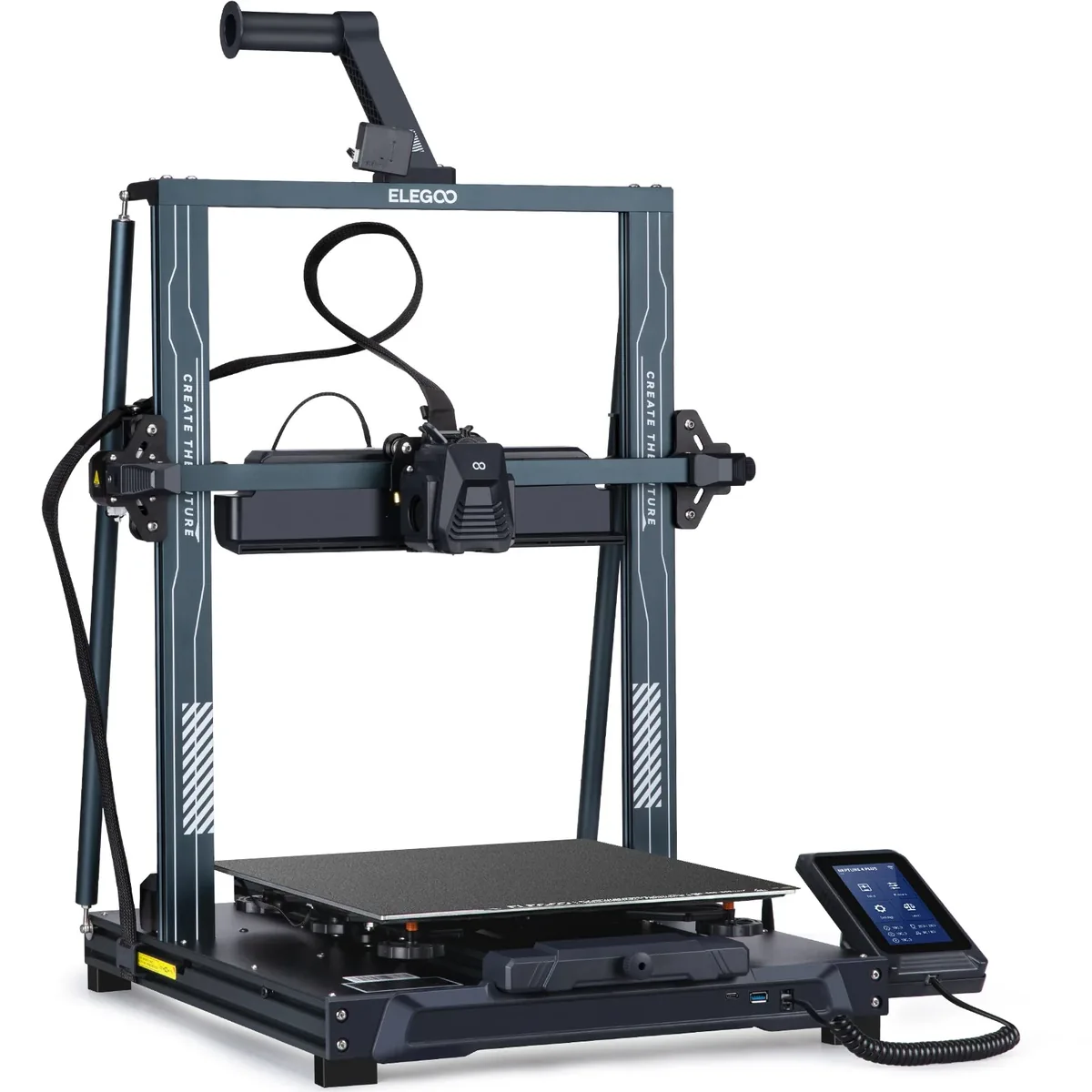
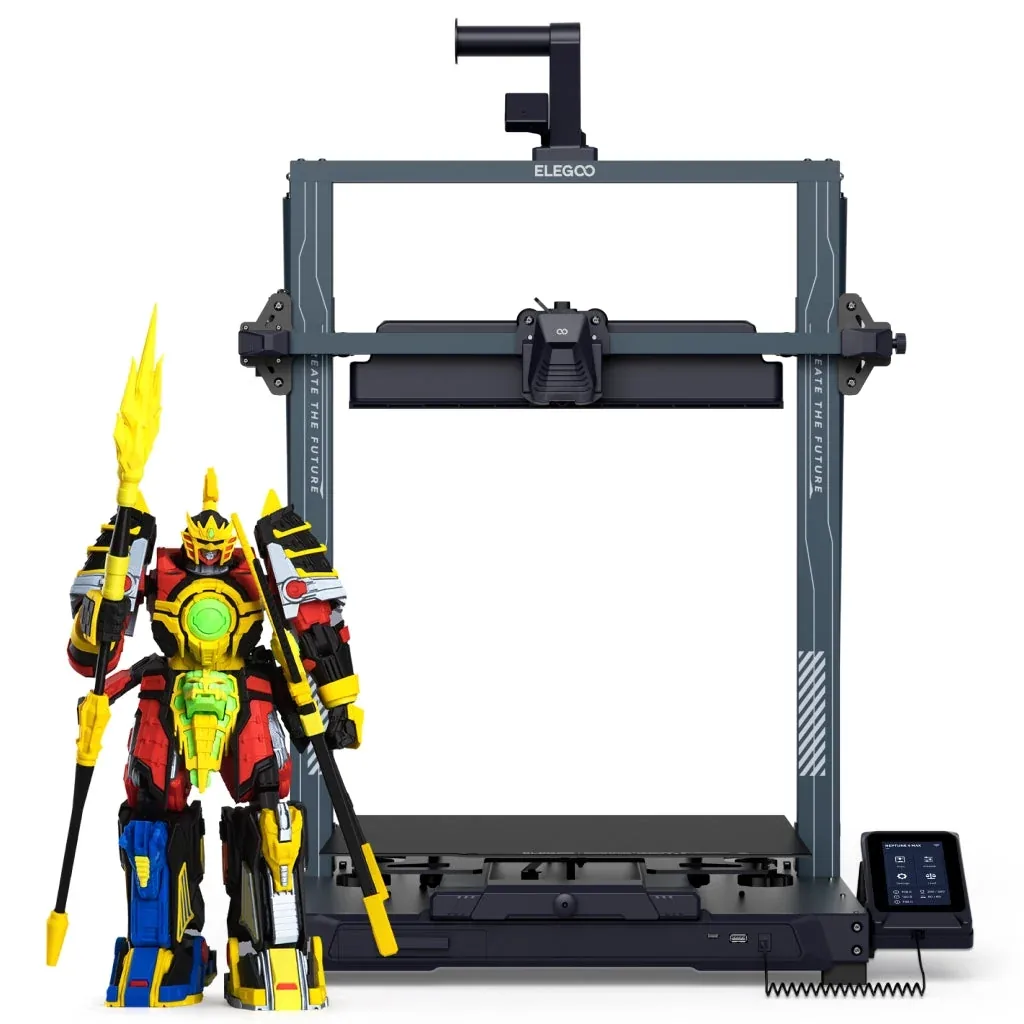
Only the SV08 Max, at three times the price, prints a part wider than this, and at $389 the Neptune 4 Max costs less than most 256 mm cubes. Eighty-five litres is roughly five times a P1S and nearly twice the Prusa XL's, for a tenth of the XL's price. The caveats scale with the bed: a 420 mm platform moving in Y has enormous inertia, the 121-point mesh is doing serious work to keep a plate that size flat, and a print filling the volume runs for days on an open frame with no camera to watch it. Warping is the real enemy at this scale — a part 400 mm long shrinks measurably as it cools, which is why the 110 °C bed matters more here than anywhere else. For signage, cosplay shells and full-size props in PLA or PETG, it has no competition on price.
- Approx. price
- ~$389
- Build volume
- 84.7 L
- Per litre
- $5
- True multi-material price
- No changer offered
Real speed ceiling
Not published
Elegoo does not publish a volumetric flow rate for the Neptune 4 Max, so its 500 mm/s claim cannot be checked against what the hotend can actually melt. We do not estimate one.
Best forFull-size props, signage and cosplay shells printed in one piece rather than glued together.
Specifications
- Build volume
- 420 × 420 × 480 mm
- Volume
- 84.7 L
- Motion
- bedslinger
- Max speed
- 500 mm/s
- Acceleration
- 8,000 mm/s²
- Max flow
- Not published
- Hotend max temp
- 300 °C
- Bed max temp
- 110 °C
- Enclosure
- Open frame
- Extruder
- direct drive
- Auto level
- probe
Materials, control and build
- Multi-material
- None offered
- Firmware
- Klipper
- Cloud
- Optional
- Camera
- No
- Assembly
- Partly assembled
- Weight
- 21 kg
- Footprint
- 675 × 660 × 745 mm
Features
- 420 × 420 × 480 mm — 84.7 litres, second only to the SV08 Max
- 110 °C bed across the full platform
- 121-point automatic levelling
- Klipper with input shaping
- Dual Z lead screws with a reinforced gantry
What it does well
- 84.7 litres at $389 — the cheapest litre of build volume in this catalogue
- 110 °C across a 420 mm bed is what keeps big parts from lifting at the corners
- Klipper, input shaping and a dense levelling mesh on a machine this cheap
- Prints in one piece what almost every other printer here needs cut into sections and glued
Where it gives ground
- A 420 mm bed moving in Y has huge inertia — real speeds are a fraction of the 500 mm/s claim
- Open frame, so large parts in anything but PLA and PETG will warp
- Multi-day prints with no camera and no enclosure to protect them
- 675 × 660 mm of desk and 21 kg, plus partial assembly
- No published flow rate to size the throughput of very large prints
The points above are read off published specifications, not from owner reports.
What owners report
Drawn from owner discussions in 3D-printing communities, not from our own testing — this site has no test lab.
What owners like
- Owners name it directly when asking which large-format printer offers the best value, and the answers largely agree
- The build volume genuinely enables projects that otherwise need sectioning and gluing, and owners post substantial designed-from-scratch work made on it
- Klipper underneath means the tuning levers that matter on a machine this size are all available
- Cheap enough that the size-per-dollar argument overrides most of its faults
Common complaints
- Ripple banding is the characteristic complaint, reported as worse on the X axis than the Y and appearing in a regular repeating pattern
- Owners describe working through full bed levelling and tilt-screw calibration without resolving print problems, to the point of losing confidence in the process entirely
- A bed this large slinging in Y is the hardest possible case for ringing, and the banding reports are consistent with that
- No enclosure, so 85 litres of anything but PLA and PETG will warp
- No camera on a machine whose prints routinely run for days
The Neptune 4 Max is bought for one number and owner discussions confirm it: nothing else prints a 420 mm part for this money, and when people ask which large-format printer is the best value, this is the answer that comes back. Owners post substantial original work made on it, including designed-from-scratch pieces that simply would not fit elsewhere.
The characteristic problem is ripple banding, described as a regular repeating pattern and specifically worse along the X axis than the Y. That is consistent with the physics of the machine — a very large, heavy bed reversing direction on every layer is the worst case for resonance — and it is the reason its practical speed is far below its rating on anything tall.
The more discouraging reports come from owners who have done everything correctly. Full bed levelling, tilt-screw calibration, methodical work through the documented procedures, and still not getting acceptable results is a pattern that appears more than once, in one case to the point of the owner questioning filament printing generally. Buy it for size, budget time for tuning, and keep expectations for surface finish modest.
Questions owners ask
+What causes the ripple banding?
Owners report it as a regular repeating pattern, worse on X than Y. On a bed this size the most likely contributors are frame resonance from the large moving mass and belt tension. Lowering acceleration and speed helps more here than on smaller machines, because the inertia being managed is genuinely larger.
+Is it the best value large-format printer?
On volume per dollar, owners largely agree that it is — nothing else prints a 420 mm part at this price. The qualifications are that it is an open frame, so the materials list is short, and that surface finish on tall parts takes tuning that smaller machines do not need.
+Can it print ABS or ASA at size?
No. There is no enclosure, and a large part in ABS or ASA will contract unevenly as it cools and lift off the plate or split along a layer line. The larger the part, the worse it gets — which is unfortunate given that size is the entire reason to buy this machine.
+I've calibrated everything and prints still fail. What now?
Owners have reached exactly that point after full bed levelling and tilt-screw calibration. The things worth revisiting are frame squareness, belt tension, and whether the printer is on a surface rigid enough for a bed this heavy — a flexing table will reproduce banding no amount of calibration fixes.