 FDM enclosed~$299
Elegoo · released 2025
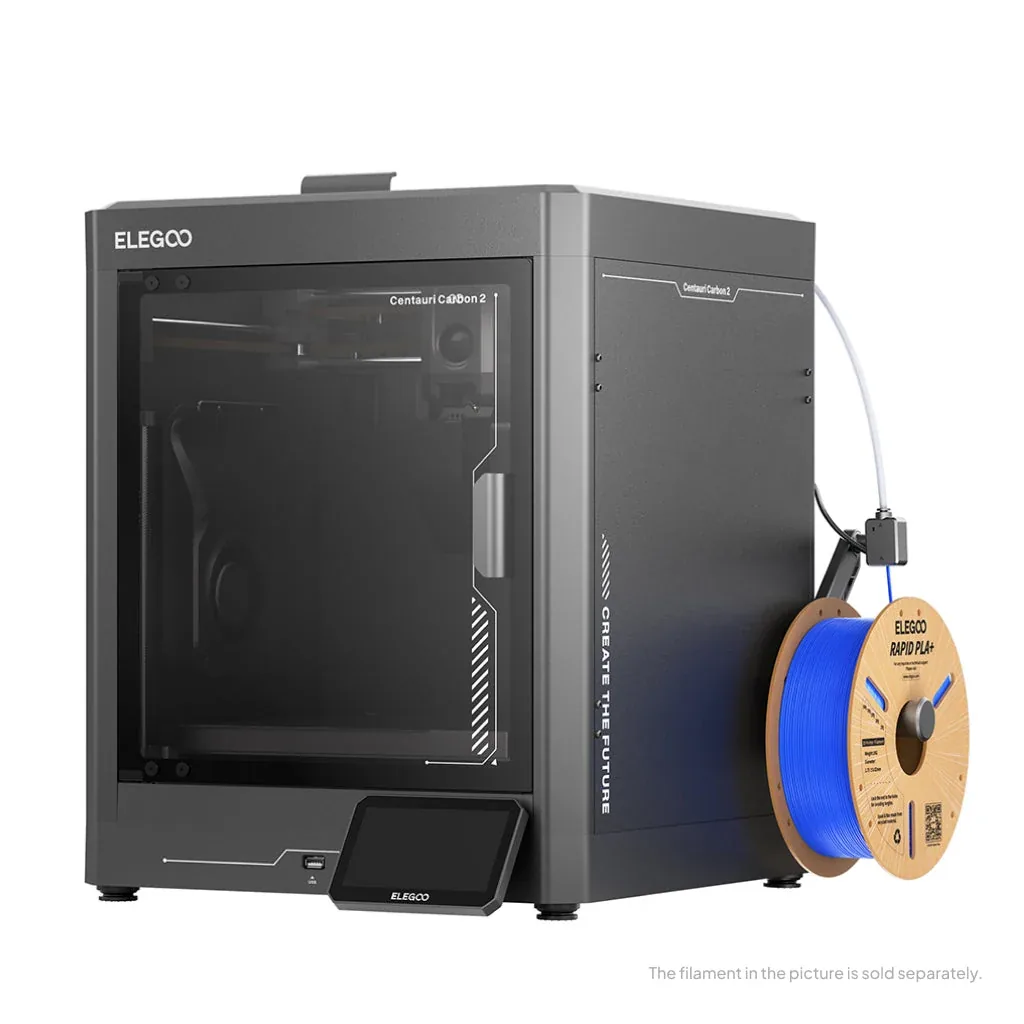
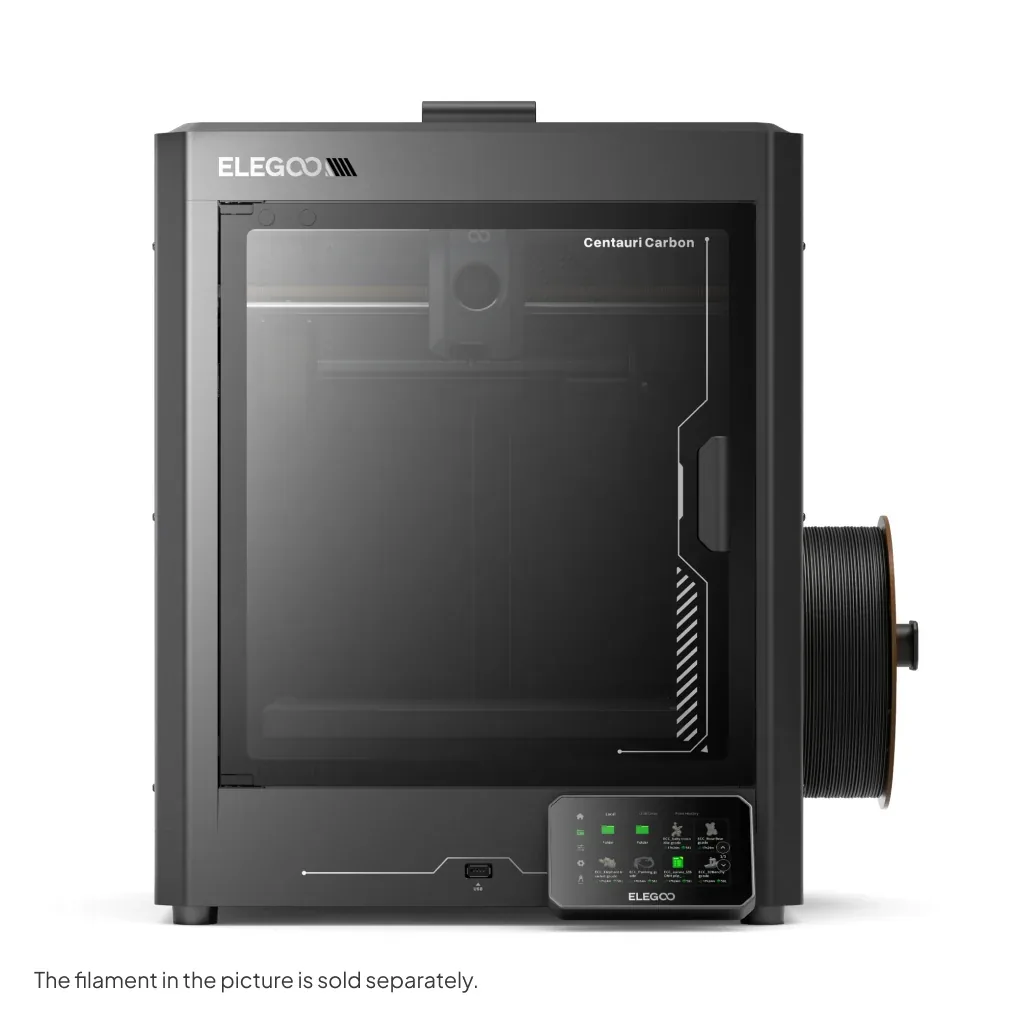
Elegoo Centauri Carbon
The machine that made everyone recalculate what an enclosed CoreXY should cost. Elegoo launched it at $299 with a hardened steel 320 °C nozzle, a 32 mm³/s published flow rate, linear rails, a strain-gauge levelling system and a camera — a specification that had been $700 territory the year before, and it is the reason the P1S now sells for $399. Crucially it publishes its flow rate, so the 500 mm/s claim can be checked: 32 mm³/s at 0.4 × 0.2 mm works out to about 400 mm/s of real line speed, which is among the highest honest figures here. The firmware is a locked-down Klipper with Fluidd rather than an open install. Supply was the recurring problem — it sold out repeatedly through 2025 — and it has now been replaced by the Centauri Carbon 2, so this is the end-of-line bargain rather than the current model.
- Approx. price
- ~$299
- Build volume
- 16.8 L
- Per litre
- $18
- True multi-material price
- No changer offered
Real speed ceiling
400 mm/s
32 mm³/s ÷ (0.4 mm × 0.2 mm) = 400 mm/s. The Centauri Carbon is advertised at 500 mm/s, so the hotend can feed 80% of the headline figure. An estimate for a straight line at the hotend’s rated flow — real prints are slower again.
Best forThe cheapest way into enclosed CoreXY printing with a hardened nozzle already fitted.
Specifications
- Build volume
- 256 × 256 × 256 mm
- Volume
- 16.8 L
- Motion
- CoreXY
- Max speed
- 500 mm/s
- Acceleration
- 20,000 mm/s²
- Max flow
- 32 mm³/s
- Hotend max temp
- 320 °C
- Bed max temp
- 110 °C
- Enclosure
- Enclosed, unheated chamber
- Extruder
- direct drive
- Auto level
- strain-gauge
- Hardened nozzle
- Yes, as standard
Materials, control and build
- Multi-material
- None offered
- Firmware
- Klipper
- Cloud
- Optional
- Camera
- Yes
- Assembly
- Pre-assembled
- Weight
- 15 kg
- Footprint
- 398 × 404 × 490 mm
Features
- Enclosed CoreXY 256 mm cube with linear rails
- Published 32 mm³/s flow from a hardened 320 °C nozzle
- Strain-gauge levelling and automatic Z offset
- Klipper with a Fluidd interface and a built-in camera
- Filtered chamber exhaust for ABS and ASA
- Dual-sided flexible spring steel print sheet
What it does well
- Publishes a real flow rate, unlike the Bambu machines it is priced against
- Hardened 320 °C nozzle as standard means carbon-filled filament on day one
- Enclosure, camera, linear rails and Klipper at a price that undercut everything at launch
- Directly responsible for pushing the enclosed-CoreXY price floor down across the market
- Same 256 mm cube as machines costing twice as much
Where it gives ground
- Superseded by the Centauri Carbon 2, so it is end-of-line stock
- Klipper is locked down — no Mainsail or custom macros without unofficial routes
- Chamber is passive, so large ABS parts still warp
- Was chronically out of stock through its life, and availability is still patchy
- No multi-material option at all on this generation
The points above are read off published specifications, not from owner reports.
What owners report
Drawn from owner discussions in 3D-printing communities, not from our own testing — this site has no test lab.
What owners like
- The value reaction from owners is close to unanimous — one widely repeated summary calls it a beast for the money, and its launch price genuinely reset expectations for an enclosed CoreXY
- Head-to-head print tests posted by owners put it ahead of machines costing several times more on the same model with the same settings
- Elegoo released the modified Klipper source after community pressure, which owners treated as a meaningful reversal rather than a token gesture
- The included sample print is consistently described as immaculate, which sets an accurate expectation of what the machine can do
- Hardened nozzle and enclosure as standard put filled filaments and ASA on the table at a price where neither is usually offered
Common complaints
- Owners report needing real calibration work after the first print — droopy or disconnected extrusion in corners and on curves is the specific repeated symptom
- Noise is noticeable, and owners who mention it tend to dismiss it only because they do not sleep next to it
- The locked-down firmware was a genuine grievance before the source release, and the interface remains more restricted than open Klipper
- Supply was chronically short, with owners describing long waits, and availability has stayed uneven
- The speed comparison that flatters it is against a printer with a different design philosophy, and owners note quality tuning is where the extra money elsewhere goes
The Centauri Carbon is the machine that moved the price floor for enclosed CoreXY printing, and owner reaction to it is unusually enthusiastic for a budget product. Head-to-head tests posted by owners — the same model, the same settings, across several machines — put it ahead of printers costing several times more on print time, and the benchy it ships with is consistently described as immaculate.
The experience after that first print is where the qualifications appear. Owners frequently report needing to do real calibration work, with droopy or disconnected extrusion on corners and curves as the specific symptom. That is a very different ownership experience from a machine that simply works, and it is the main thing separating this from pricier competitors.
The other defining episode was firmware. Elegoo shipped a modified Klipper without publishing the source, which drew sustained criticism, and then released the code — a reversal owners treated as significant rather than cosmetic. Supply has been the persistent practical problem: the machine sold out repeatedly and availability has remained uneven, which is worth factoring in alongside its successor now being on sale.
Questions owners ask
+Is the Centauri Carbon really as fast as printers costing three times more?
On the evidence owners have posted — the same model sliced with the same settings across several machines — it prints competitively with far more expensive printers and finished notably ahead of at least one. Print time is not the same as print quality, and the tuning work described below is where the gap reappears.
+What calibration does it need out of the box?
Owners report the shipped sample print being excellent and subsequent prints needing work, with the common symptom being droopy or broken extrusion on corners and curves. Flow and pressure-advance calibration is where most people start. Expect to spend an evening on it rather than printing perfectly from the first custom file.
+Is the firmware open?
Partly. It runs a modified Klipper that Elegoo initially shipped without publishing the source, which drew substantial criticism; the company subsequently released the code. The running interface is still more restricted than a stock Klipper install, so treat it as open-source-derived rather than as an open machine.
+How loud is it?
Noticeable. Owners who raise it generally conclude it does not matter to them because the printer is not in the room they sleep in — which is a useful way of framing the answer. If it will share a bedroom or a quiet office, it is worth weighting.
+Should I buy this or the Centauri Carbon 2?
The newer model raises the nozzle to 350 °C and adds a four-colour option, both of which are real. This one is cheaper and end-of-line. If polycarbonate or multi-colour matters to you, the newer machine; if not, this is the same core printer for less, subject to finding one in stock.