 FDM enclosed~$1,199
Prusa · released 2024
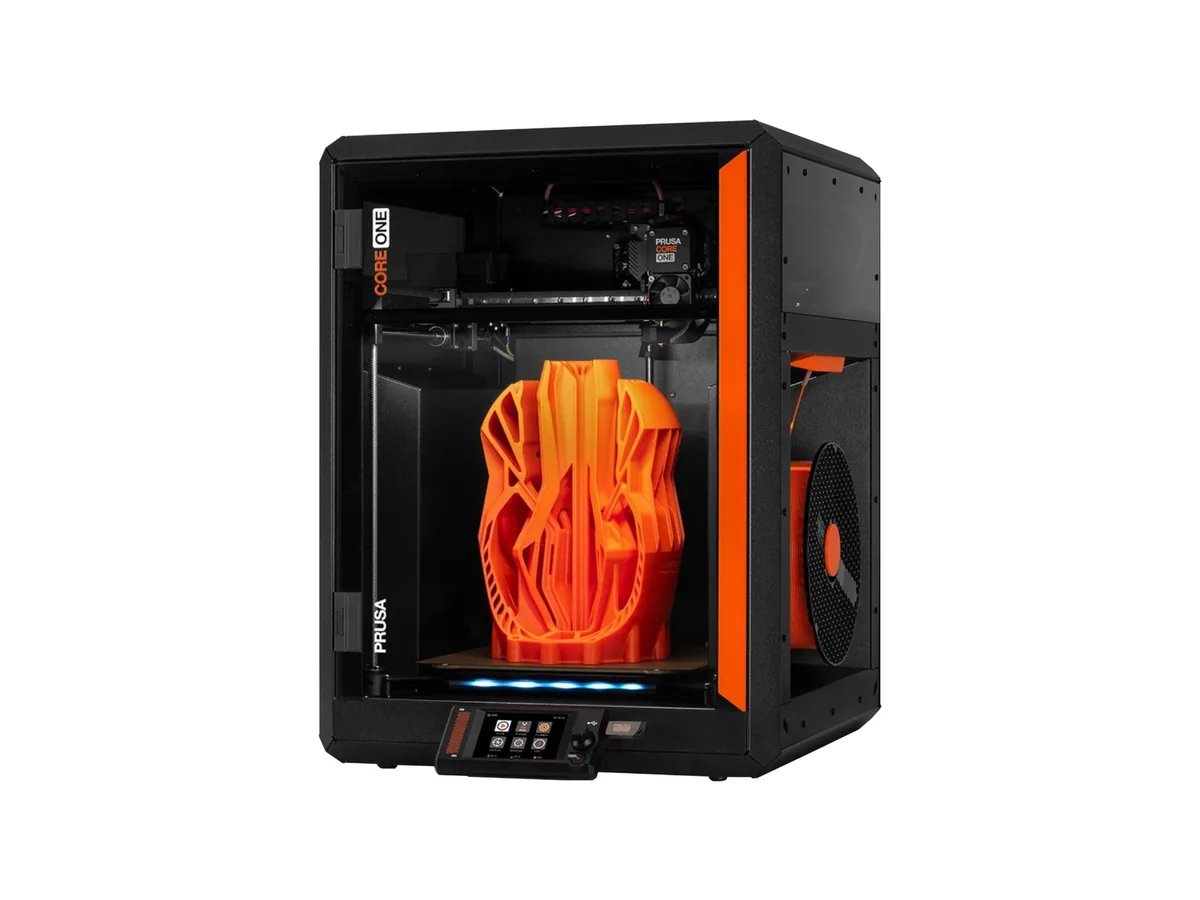
Original Prusa CORE One
After a decade of bed-slingers Prusa finally built a CoreXY, and the interesting decision is the chamber: rather than a passive box, the CORE One actively manages chamber air up to 55 °C using the print's own waste heat and a controlled vent. That is lower than the 65 °C the Bambu H-series and Qidi machines drive to, but it is a managed temperature rather than whatever the enclosure happens to trap, and it makes ASA and ABS behave. Sheet steel panels mount from the outside, so the machine can be opened for service without dismantling the frame — a very Prusa answer to a very real problem with sealed appliances. The 24 mm³/s high-flow nozzle carries over from the MK4S, meaning about 300 mm/s of genuine line speed. It is priced against machines with more build volume, and the argument for it is openness and serviceability rather than specification.
- Approx. price
- ~$1,199
- Build volume
- 14.8 L
- Per litre
- $81
- True multi-material price
- ~$1,498
Real speed ceiling
300 mm/s
24 mm³/s ÷ (0.4 mm × 0.2 mm) = 300 mm/s. The CORE One is advertised at 500 mm/s, so the hotend can feed 60% of the headline figure. An estimate for a straight line at the hotend’s rated flow — real prints are slower again.
Best forABS and ASA work where you want an open, repairable machine rather than a sealed appliance.
Specifications
- Build volume
- 250 × 220 × 270 mm
- Volume
- 14.8 L
- Motion
- CoreXY
- Max speed
- 500 mm/s
- Acceleration
- 8,000 mm/s²
- Max flow
- 24 mm³/s
- Hotend max temp
- 300 °C
- Bed max temp
- 120 °C
- Enclosure
- Heated chamber to 55 °C
- Extruder
- direct drive
- Auto level
- strain-gauge
Materials, control and build
- Multi-material
- MMU3, 5 slots
- True multi-material price
- ~$1,498 (+~$299)
- Firmware
- PrusaFirmware
- Cloud
- Optional
- Camera
- No
- Assembly
- Pre-assembled
- Weight
- 17 kg
- Footprint
- 415 × 444 × 555 mm
Features
- Actively managed chamber up to 55 °C
- CoreXY motion in a 250 × 220 × 270 mm enclosed frame
- Same 24 mm³/s published flow as the MK4S
- Externally mounted steel panels for service access
- MMU3 five-filament support and open firmware
- Removable spring steel print sheets, textured and smooth
What it does well
- Chamber temperature is actively managed rather than left to whatever the box traps
- Publishes a 24 mm³/s flow figure, so the 500 mm/s claim can be checked against it
- Panels come off from outside — servicing does not mean disassembling the printer
- Open firmware and complete spare-part availability, unusual at this price point
- MMU3 gives five filaments where most rivals stop at four
- Fits a 270 mm tall part, taller than the 256 mm Bambu cubes it competes with
Where it gives ground
- 55 °C chamber is 10 °C below the Bambu X2D and Qidi machines, and the X2D costs half as much
- No camera and no hardened nozzle included at $1,199
- Build volume is modest for the price — several large-format machines cost less
- Flow rate is well below the 40–50 mm³/s of the Qidi and Sovol competition
The points above are read off published specifications, not from owner reports.
What owners report
Drawn from owner discussions in 3D-printing communities, not from our own testing — this site has no test lab.
What owners like
- The managed chamber is the feature owners cite for choosing it, specifically for venting properly and printing ABS and ASA without an improvised enclosure
- An official multi-tool add-on brings independent tool changing with abrasion-resistant and high-flow nozzles to this frame, which is an unusual upgrade path for an already-purchased printer
- Owners moving from a Bambu machine to this one consistently cite noise, open firmware and the absence of cloud dependency as their reasons, rather than print quality
- MK4 and MK4S owners can convert to this frame with an official kit rather than buying a whole new printer
- Continues to receive substantial platform updates — a second-generation revision arrived without obsoleting the first
Common complaints
- Value is the persistent criticism: owners openly question who it is for when cheaper machines offer more build volume and similar capability
- The larger L variant took a price increase after launch, which owners noted unhappily
- The chamber tops out lower than the 65 °C driven chambers on several cheaper machines, and owners comparing spec sheets raise this
- The multi-tool add-on costs a substantial fraction of the printer again, so the fully-equipped machine is well beyond its headline price
- No camera included at this price, where much cheaper competitors ship one
The CORE One is Prusa's first CoreXY and it arrived into a market where its specification is not the argument. Owner discussions about it are unusually explicit about that: threads asking who it is actually for, comparing it against machines with more build volume for less money, are common and are not written by detractors. The answers that come back are consistently about ownership rather than throughput — open firmware, no cloud requirement, serviceability, a managed chamber temperature, and a company that sells parts indefinitely.
The development story is the more interesting part. An official multi-tool add-on brings genuine independent tool changing to this frame, with abrasion-resistant high-flow nozzles and several materials loaded at once — a capability that previously required a far more expensive machine. MK4 and MK4S owners can convert to the CORE One frame with a kit rather than replacing the printer. Both are unusual in a category where last year's machine is normally just last year's machine.
The counterweights are cost and chamber temperature. The add-ons stack up quickly, and the chamber runs cooler than the 65 °C driven chambers on several machines costing half as much.
Questions owners ask
+CORE One or a Bambu P1S?
The most common comparison in owner discussions, and the answers divide cleanly. The P1S is substantially cheaper with a better-developed multi-material ecosystem. The CORE One is open, repairable, quieter, has a managed chamber rather than a passive box, and a taller build volume. Owners who switch from Bambu to Prusa cite noise and openness; those who go the other way cite price.
+What does the multi-tool add-on change?
It brings independent tool changing to the CORE One — several materials loaded simultaneously with different nozzle sizes, abrasion-resistant tips and high-flow capability, without the purge waste a filament changer produces. It costs a significant fraction of the printer again, so budget for the complete machine rather than the headline price.
+Is the chamber actually heated?
It is actively managed rather than passively trapped, reaching about 55 °C. That is meaningfully better than an unheated enclosure for ABS and ASA, but lower than the 65 °C chambers on several cheaper machines — a gap owners comparing spec sheets do raise.
+Should I convert my MK4S instead of buying one?
Prusa sells an official conversion kit and owners have completed it successfully. It is cheaper than a new printer and keeps your existing electronics. The practical catch owners mention is being left with a substantial pile of leftover MK4S parts and nowhere obvious to put them.
+Is it worth it over a cheaper enclosed machine?
On specification alone, generally not — that is precisely the question owners keep asking. The case for it rests on open firmware, no cloud dependency, indefinite parts availability, lower noise and an upgrade path that has so far been real rather than promised. Whether that is worth several hundred dollars is a judgement about how you want to own a machine, not about print quality.