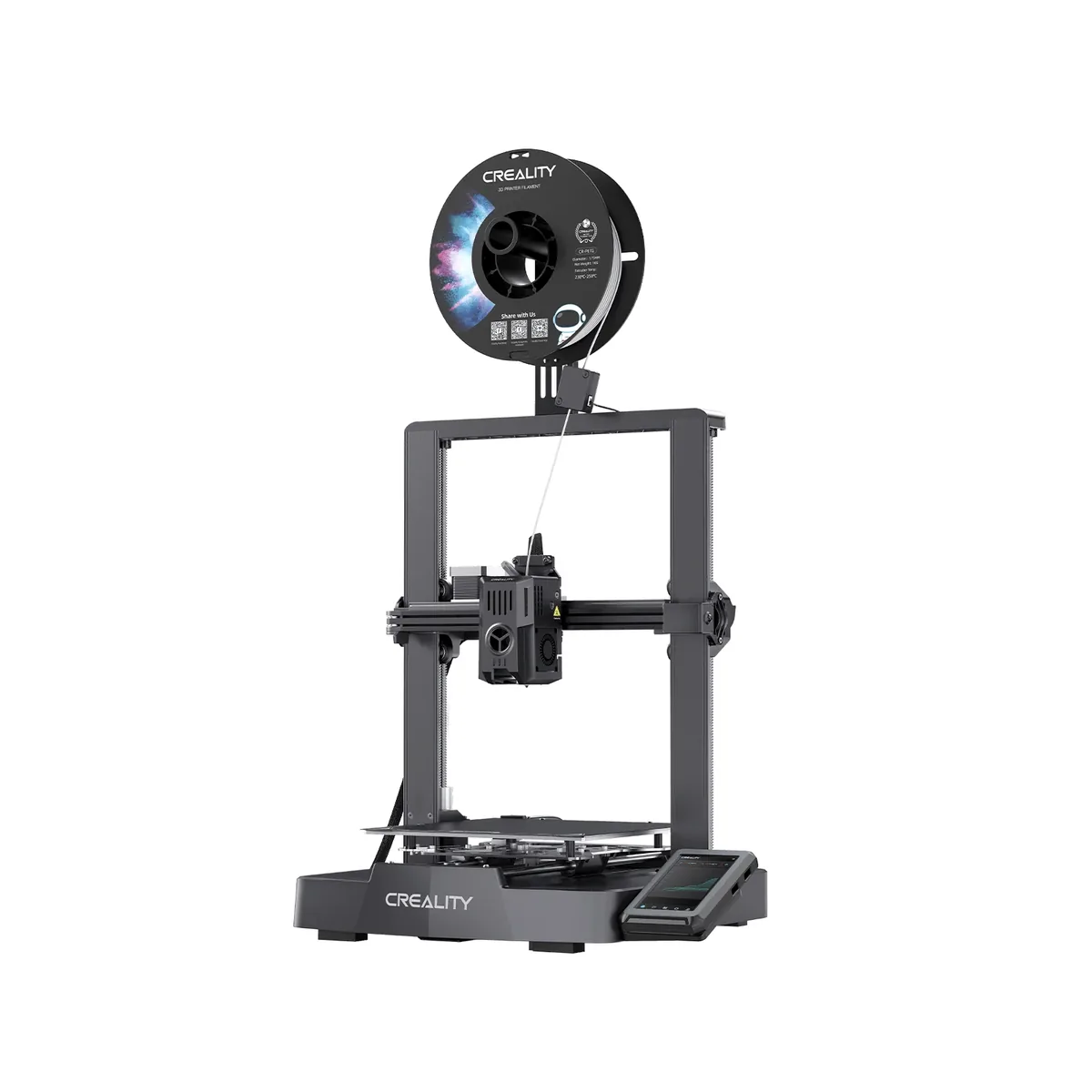
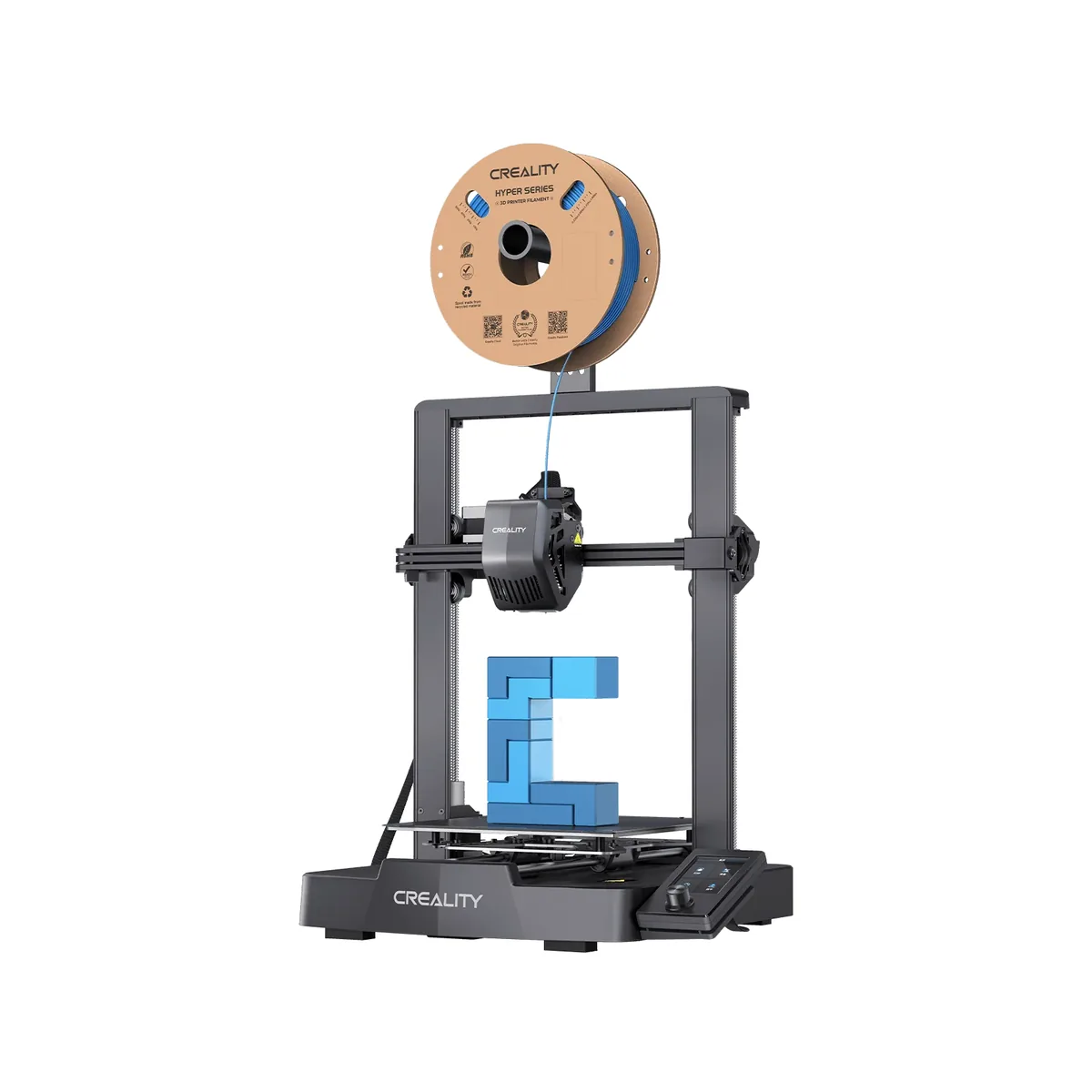
 FDM bedslinger~$199
Creality · released 2023
Creality Ender-3 V3 SE
4.8★ from 113 buyer reviews on Creality store
Cheapest way into the hobby that is not a gamble. The V3 SE took the old Ender 3 formula — a 220 × 220 bed on an aluminium frame, assembled from a box — and fixed the two things that made the original a project rather than a printer: it has a direct-drive extruder and it levels itself with a CR Touch probe, so the endless bed-tramming ritual is gone. What you give up at $199 is everything modern: 260 °C hotend, no input shaping, 250 mm/s that is a genuine ceiling rather than a marketing one, and Marlin firmware without a network stack worth using. It still asks for about an hour of assembly. For a first printer where the budget is the binding constraint, or a machine that can be abandoned mid-project without regret, it remains the sensible floor of the market — but a Bambu A1 mini costs only slightly more and behaves like a finished product.
- Approx. price
- ~$199
- Build volume
- 12.1 L
- Per litre
- $16
- True multi-material price
- No changer offered
Real speed ceiling
Not published
Creality does not publish a volumetric flow rate for the Ender-3 V3 SE, so its 250 mm/s claim cannot be checked against what the hotend can actually melt. We do not estimate one.
Best forA first printer on a tight budget, where price matters more than speed or materials.
Specifications
- Build volume
- 220 × 220 × 250 mm
- Volume
- 12.1 L
- Motion
- bedslinger
- Max speed
- 250 mm/s
- Acceleration
- 2,500 mm/s²
- Max flow
- Not published
- Hotend max temp
- 260 °C
- Bed max temp
- 100 °C
- Enclosure
- Open frame
- Extruder
- direct drive
- Auto level
- probe
Materials, control and build
- Multi-material
- None offered
- Firmware
- Marlin
- Cloud
- Optional
- Camera
- No
- Assembly
- Partly assembled
- Weight
- 7.1 kg
- Footprint
- 420 × 420 × 490 mm
Features
- 220 × 220 × 250 mm build volume on an aluminium frame
- Sprite direct-drive extruder
- CR Touch automatic bed levelling with dual Z lead screws
- Ships partly assembled — roughly an hour to build
- PC-coated spring steel removable print sheet
What it does well
- Auto-levelling and direct drive at $199 remove the two failure modes that defined the original Ender 3
- Enormous community: parts, mods, profiles and troubleshooting for this frame are everywhere
- Simple enough to repair with basic tools and cheap spares
- Assembly is short and genuinely instructive without being a full kit build
Where it gives ground
- 260 °C hotend and no enclosure limit it to PLA, PETG and TPU
- 250 mm/s with no input shaping makes it several times slower than current machines in practice
- No camera, no network features worth using, no multi-material path
- Not hardened — abrasive filaments destroy the stock nozzle quickly
- An A1 mini costs slightly more and needs no assembly or tuning at all
The points above are read off published specifications, not from owner reports.
What owners report
Drawn from owner discussions in 3D-printing communities, not from our own testing — this site has no test lab.
What owners like
- Owners regularly report an excellent first print straight out of the box, which is a genuine change from the older Ender generations this replaces
- At its frequent sale price it is the cheapest credible entry into the hobby, and owners weighing it against a Bambu A1 mini are usually deciding on about $20
- Auto-levelling and direct drive remove the two things that made the original Ender 3 a project rather than a printer
- The community around this frame is vast, so almost any problem has been documented and solved by someone already
- Cheap and simple enough that owners treat replacing a part as routine rather than as a disaster
Common complaints
- Frame and assembly quality control is the recurring complaint — owners report gantry uprights where one side seats in its hole and the other does not
- Layer drift and shifting mid-print appear repeatedly, persisting for some owners after belt tensioning and rod checks
- Print-to-print inconsistency is a common theme: identical G-code producing different results, with owners running full calibration suites and still returning the printer
- Once tuning stalls, the advice owners receive is usually to buy something else, which tells you how the value comparison lands
- Slow by current standards, with no input shaping to make the speed claim meaningful
The V3 SE is the machine that made the Ender line tolerable, and owner discussions reflect exactly that ambivalence. First prints are often genuinely good, which surprises people arriving from older Enders, and auto-levelling plus a direct-drive extruder removes the rituals that defined the previous generation. At its sale price it is the cheapest sensible way to find out whether 3D printing suits you.
What owners report going wrong is mechanical and inconsistent rather than uniform. Frame assembly problems come up specifically — reports of gantry uprights that will not seat squarely in both holes at once. Layer drift and shifting mid-print recur, and some owners describe tensioning belts, checking rods and running full calibration suites without resolving it. The pattern that matters is inconsistency: the same file printing well once and badly the next time is harder to live with than a printer that is reliably mediocre.
The decision almost every buyer is actually making is this against a Bambu A1 mini at roughly the same money, and the advice owners give each other leans consistently toward paying the small difference for the machine that needs no assembly and no tuning.
Questions owners ask
+Ender 3 V3 SE or a Bambu A1 mini?
These two are usually within about $20 of each other on sale, and owner advice leans clearly toward the A1 mini: it needs no assembly, no tuning, and has better failure detection. The Ender's arguments are a slightly larger bed and a bigger community of documented fixes. If you want to tinker, the Ender; if you want to print, the Bambu.
+Why is my print drifting or shifting layers?
This is one of the most-reported problems on this machine. The usual checks are belt tension on X and Y, the Z rods, and whether anything is fouling the gantry. Some owners report the drift persisting after all of those, in which case the frame's squareness is the next thing to examine — assembly quality on this model is the recurring complaint.
+Is assembly difficult?
It is about an hour of straightforward work, but quality control is the weak point: owners have posted about gantry uprights where the mounting holes do not line up on both sides simultaneously. Check the frame is square before you print, because a frame that is not square produces exactly the drift and inconsistency problems described above.
+Can it print PETG or ABS?
PETG yes, with the 100 °C bed. ABS no — the 260 °C hotend is marginal and there is no enclosure, so parts warp. Owners wanting those materials generally treat this as a starter machine and buy an enclosed printer later.