 FDM enclosed~$369
Creality · released 2024
Creality K1C
4.8★ from 147 buyer reviews on Creality store
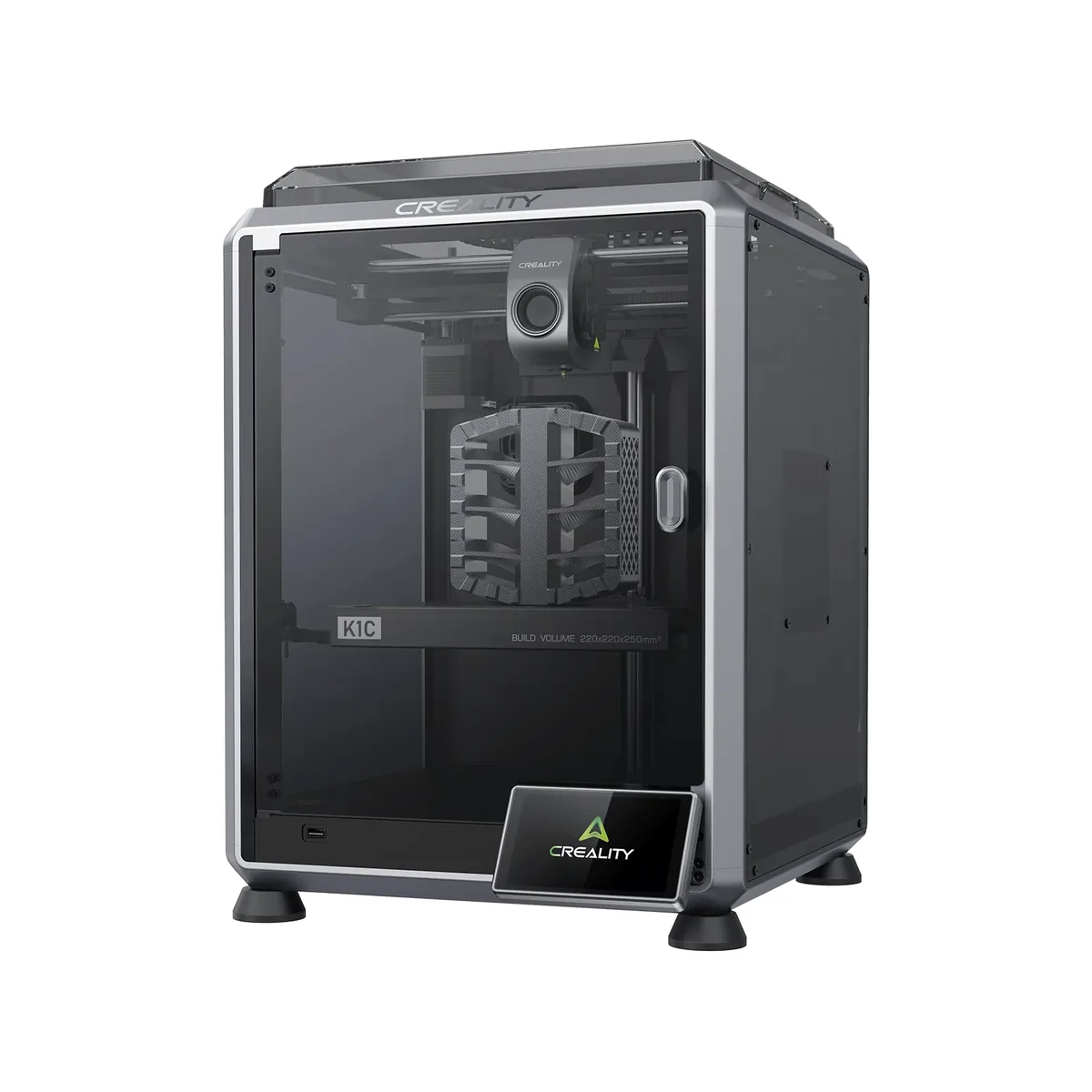
The C in K1C stands for carbon, and the machine is built around that premise: a hardened steel tri-metal nozzle as standard, an enclosed chamber, a direct-drive extruder with a short filament path, and a 32 mm³/s rated flow that is high for the money. Carbon-filled nylon and PA-CF are the intended diet, and unlike most printers claiming them, the parts that abrasive filament destroys are already the hard versions. It runs Klipper, has a camera with AI failure detection, and covers a 220 × 220 × 250 mm volume. Against a Bambu P1S at $399 it is cheaper, has a published flow rate the P1S lacks, and gives up build volume, refinement and the AMS ecosystem. The complaints that follow Creality around — inconsistent QC and slow support — apply here too, and are the reason to weigh the $30 saving carefully.
- Approx. price
- ~$369
- Build volume
- 12.1 L
- Per litre
- $30
- True multi-material price
- No changer offered
Real speed ceiling
400 mm/s
32 mm³/s ÷ (0.4 mm × 0.2 mm) = 400 mm/s. The K1C is advertised at 600 mm/s, so the hotend can feed 67% of the headline figure. An estimate for a straight line at the hotend’s rated flow — real prints are slower again.
Best forPrinting carbon-filled and abrasive engineering filaments on a budget.
Specifications
- Build volume
- 220 × 220 × 250 mm
- Volume
- 12.1 L
- Motion
- CoreXY
- Max speed
- 600 mm/s
- Acceleration
- 20,000 mm/s²
- Max flow
- 32 mm³/s
- Hotend max temp
- 300 °C
- Bed max temp
- 100 °C
- Enclosure
- Enclosed, unheated chamber
- Extruder
- direct drive
- Auto level
- strain-gauge
- Hardened nozzle
- Yes, as standard
Materials, control and build
- Multi-material
- None offered
- Firmware
- Klipper
- Cloud
- Optional
- Camera
- Yes
- Assembly
- Pre-assembled
- Weight
- 12.5 kg
- Footprint
- 355 × 355 × 480 mm
Features
- Hardened tri-metal nozzle fitted as standard for abrasive filament
- Published 32 mm³/s flow rate
- Enclosed chamber with a 300 °C hotend
- Klipper firmware with input shaping
- Camera with AI print-failure detection
What it does well
- Hardened nozzle and abrasion-ready parts as standard rather than as an upgrade
- Publishes a 32 mm³/s flow rate — about 400 mm/s of real line speed at 0.4 × 0.2 mm
- Enclosed CoreXY with a camera for less than the Bambu P1S
- Klipper underneath, with an active modding community
- Compact footprint for an enclosed machine
Where it gives ground
- 12.1 litres of enclosed volume is among the tightest here — noticeably smaller than a P1S
- Chamber is unheated, so ABS and ASA at size still warp
- Creality QC and support are the persistent weak point across this brand
- No multi-material option at all, where the P1S has the whole AMS ecosystem
- 100 °C bed is cooler than rivals aimed at the same engineering materials
The points above are read off published specifications, not from owner reports.
What owners report
Drawn from owner discussions in 3D-printing communities, not from our own testing — this site has no test lab.
What owners like
- Owners consolidating several older machines into one describe it as a genuine efficiency gain — one fast enclosed printer replacing a shelf of slow ones
- The hardened nozzle fitted as standard means filled filaments work on day one, which owners treat as the model's actual purpose
- Enclosed CoreXY with a camera at a price that undercuts the obvious alternative, which is what gets it onto shortlists
- Holds resale value well enough that owners discuss selling them on rather than writing them off
Common complaints
- A recurring owner complaint is spending more time fixing or replacing parts than printing, with some describing regretting the purchase within months
- Print quality drifting after several months — stringing and surface degradation appearing on a machine that previously printed well
- ABS warping and cracking is reported even by owners running the bed at 105 °C, because the enclosure is passive rather than heated
- Owners want to move off Creality's own slicer, and setting up a third-party one is documented inconsistently across the K1 family
- Unexplained corner artefacts appear in owner posts without a settled cause
The K1C is bought for one reason and owner discussions confirm it: a hardened nozzle, an enclosure and CoreXY speed at a price that undercuts the obvious alternative, aimed squarely at people who want to print carbon-filled filament without spending more. Owners consolidating a shelf of older slow printers into one fast machine describe that as a real win.
The complaints cluster around durability and drift rather than capability. The most telling recurring report is owners saying they have spent more time fixing the printer than printing on it — some of which they acknowledge as their own error, and some of which is not. Print quality degrading after several months of good service, with stringing appearing on a machine that was fine, comes up specifically. ABS warping despite a hot bed is a structural limitation rather than a fault: the enclosure traps heat but does not drive it, so large ABS parts still curl.
A smaller but persistent theme is software. Owners want to move off Creality's own slicer to something better supported, and find the documentation for doing so patchy and often written about a different model in the family.
Questions owners ask
+Can the K1C actually print ABS?
It can print small ABS parts, but owners report warping and cracking even with the bed at 105 °C and glue on the plate. The enclosure is passive — it traps heat rather than driving it to a set temperature — so large ABS parts still contract unevenly. If ABS at size is the goal, a machine with an actively heated chamber is the honest answer.
+Why has my K1C's print quality got worse over time?
Quality degrading after several months is a specific recurring report, usually appearing as stringing and poor surfaces on a machine that printed well before. The things owners check are the hotend and nozzle condition, the extruder gears, and belt tension. Filled filaments accelerate wear on all three, which is worth remembering on a printer bought specifically for them.
+Is the hardened nozzle really necessary?
If you print carbon-filled, glass-filled or glow-in-the-dark filament, yes — those destroy brass nozzles quickly. It is the K1C's main differentiator from the cheaper K1, and buying the machine for that reason is what most owners describe doing.
+Can I use a different slicer?
Owners regularly want to move off Creality's own slicer and do get there, but the community documentation is patchy and much of what turns up is written for other printers in the K1 family. Budget some time for it rather than assuming a profile will be waiting.