 Large-format FDM~$549
Creality · released 2023
Creality K1 Max
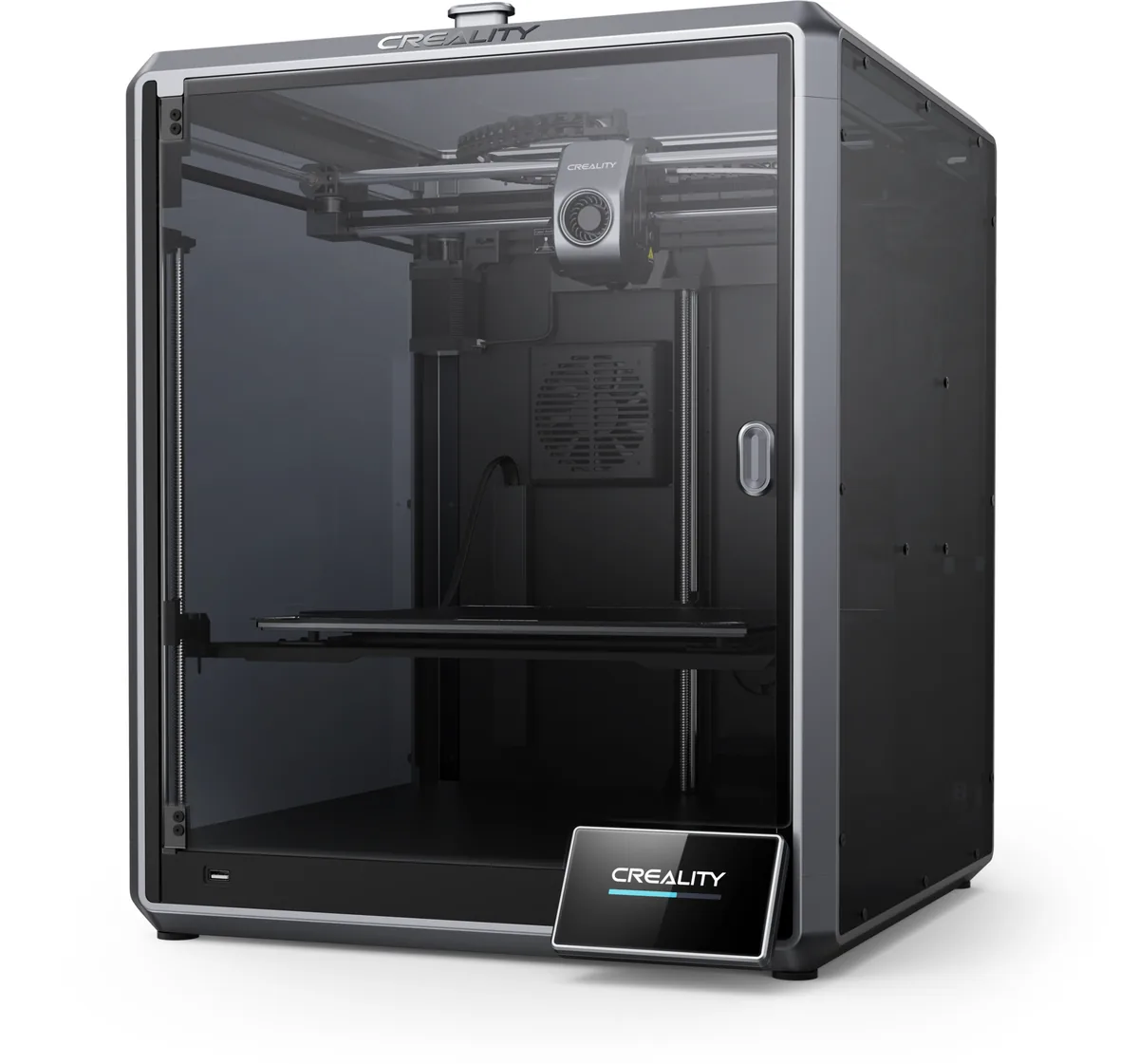
Thirty litres of enclosed build volume for $549 is the entire argument here, and it is a strong one — nothing else in this catalogue offers a 300 mm cube behind glass for that money. A lidar sensor scans the first layer and the AI camera watches for failures, features that were novel at launch and now read as a generation old. The chamber is passive, so large ABS parts still fight you, and the 100 °C bed is the practical ceiling on adhesion for a print that size. It is also the machine most associated with Creality's reliability reputation: launch units had a rough time and the platform needed firmware work. Three years on it is a known quantity with good community documentation, which arguably makes it a safer buy now than it was new — but a K2 Plus doubles down on everything it does for roughly twice the price.
- Approx. price
- ~$549
- Build volume
- 27.0 L
- Per litre
- $20
- True multi-material price
- No changer offered
Real speed ceiling
400 mm/s
32 mm³/s ÷ (0.4 mm × 0.2 mm) = 400 mm/s. The K1 Max is advertised at 600 mm/s, so the hotend can feed 67% of the headline figure. An estimate for a straight line at the hotend’s rated flow — real prints are slower again.
Best forBig enclosed prints where volume per dollar matters more than refinement.
Specifications
- Build volume
- 300 × 300 × 300 mm
- Volume
- 27.0 L
- Motion
- CoreXY
- Max speed
- 600 mm/s
- Acceleration
- 20,000 mm/s²
- Max flow
- 32 mm³/s
- Hotend max temp
- 300 °C
- Bed max temp
- 100 °C
- Enclosure
- Enclosed, unheated chamber
- Extruder
- direct drive
- Auto level
- lidar+probe
Materials, control and build
- Multi-material
- None offered
- Firmware
- Klipper
- Cloud
- Optional
- Camera
- Yes
- Assembly
- Pre-assembled
- Weight
- 18 kg
- Footprint
- 435 × 462 × 526 mm
Features
- 300 mm cube — 27 litres of enclosed build volume
- Lidar first-layer scanning plus an AI failure camera
- Published 32 mm³/s flow rate
- Klipper firmware with input shaping
- CoreXY motion behind a glass enclosure
What it does well
- 27 litres of enclosed volume at $549 works out to $20 a litre, in the best handful of enclosed machines here
- Publishes a 32 mm³/s flow rate, so the throughput claim is checkable
- Lidar first-layer scanning and AI failure detection are still uncommon at this price
- Mature platform with three years of community fixes, profiles and documented mods
Where it gives ground
- Passive chamber and a 100 °C bed make large ABS parts a fight despite the enclosure
- Launch-era reliability problems gave the platform a lasting reputation that took firmware work to fix
- Stock nozzle is not hardened, unlike the cheaper K1C
- Design is a generation behind current machines on extrusion and calibration
- No multi-material option
The points above are read off published specifications, not from owner reports.
What owners report
Drawn from owner discussions in 3D-printing communities, not from our own testing — this site has no test lab.
What owners like
- The build volume for the money is what gets it bought — owners specifically note how compact the machine is relative to the plate inside it
- Where it works, owners describe the print quality as genuinely good straight from stock presets, including in materials like ASA
- Institutional buyers report easy setup and trouble-free running, which is a different experience from the individual-owner reports
- Enough owners are positive that it holds a place on shortlists despite its reputation
Common complaints
- Reviews are unusually polarised — owners themselves note there are strongly positive and strongly negative accounts and almost nothing in between, which is a reliability-variance signature
- The sharpest owner summary is that it is a great printer but extremely unreliable, with clogging described as an almost daily occurrence traced to the extruder gears
- Layer wobble and Z-banding appear in owner posts comparing its output unfavourably against other processes
- Visible seams that owners struggle to tune out
- Its price against an enclosed Bambu alternative draws open incredulity from owners in some markets
The K1 Max is the clearest example in this catalogue of a printer whose reputation is really a statement about variance. Owners themselves point this out: the reviews split into strongly positive and strongly negative with very little in between, which is usually what you see when build quality differs unit to unit rather than when a design is simply good or bad.
The positive accounts are real. Owners get good output from stock presets, including in ASA, and note how much plate is packed into a fairly compact machine. Institutional users — a school, for instance — report straightforward setup and no trouble. The negative accounts are equally specific: one of the most-quoted owner summaries is that it is a great printer but extremely unreliable, with clogging described as an almost daily event traced to the extruder gears. Layer wobble and stubborn seams come up alongside.
The other persistent thread is price. In some markets it costs substantially more than an enclosed Bambu alternative, and owners ask openly why anyone would choose it at that difference. Where it is discounted — which is often — the calculation looks very different.
Questions owners ask
+Why are opinions on the K1 Max so divided?
Owners raise this themselves. The split into strongly positive and strongly negative accounts with little middle ground is the signature of unit-to-unit variance rather than a uniformly good or bad design. Practically, that means buying from somewhere with a real return window matters more on this machine than on most.
+Is clogging a known problem?
It is the most specific recurring mechanical complaint, and owners who have diagnosed it point at the extruder gear assembly rather than the nozzle itself. Owners describe it as frequent enough to shape their opinion of the machine. Worth researching the known fixes before buying rather than after.
+Is print quality as good as a Bambu P1S?
Owners who have asked this directly generally conclude the two are closer than the price gap suggests when the K1 Max is working properly — several report good ASA output from stock presets. The difference owners report is consistency rather than peak quality.
+Can it print ABS well given the enclosure?
The enclosure is passive, not heated, so it helps with small and medium parts but large ABS still warps. Owners printing ABS report reasonable results on moderate-sized parts and trouble as the parts get bigger, which is exactly what an unheated chamber predicts.