 Large-format FDM~$1,099
Creality · released 2024
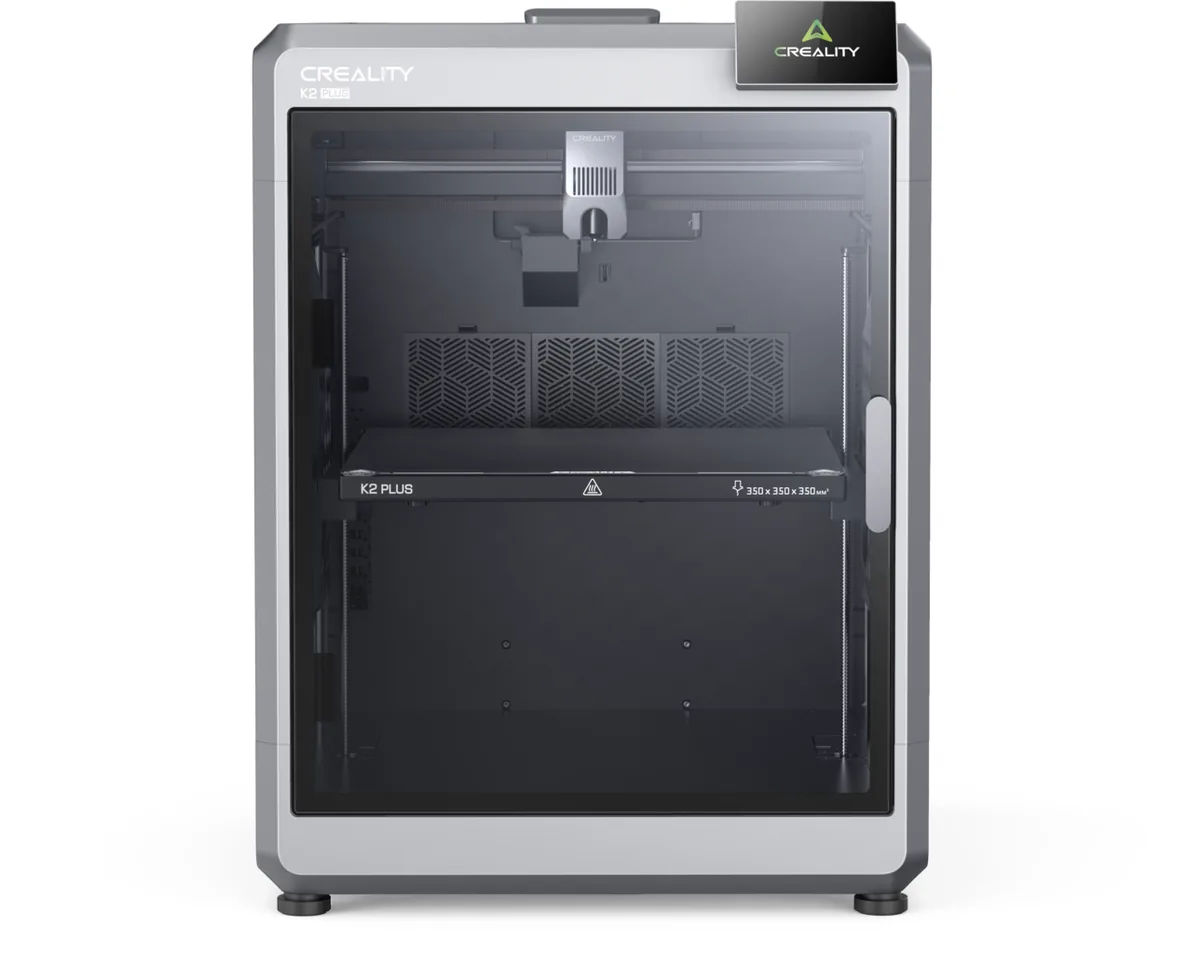
Creality K2 Plus
Creality's flagship is the most complete specification in this catalogue on paper: a 350 mm cube, an actively heated 60 °C chamber, a 350 °C tri-metal nozzle, a 120 °C bed, a published 40 mm³/s flow rate and the CFS four-spool changer that cascades to sixteen colours. That combination — big, hot, fast and multi-colour — is otherwise only available from Bambu at H-series prices. Forty-two litres is more than twice a P1S. The reason it is not the obvious default is the brand: Creality's QC variance and support responsiveness are documented across every model it makes, and a $1,099 machine is a more painful place to encounter them than a $199 one. Judged strictly on litres and degrees per dollar, nothing here beats it; judged on the likelihood of a smooth first month, several cheaper machines do.
- Approx. price
- ~$1,099
- Build volume
- 42.9 L
- Per litre
- $26
- True multi-material price
- ~$1,299
Real speed ceiling
500 mm/s
40 mm³/s ÷ (0.4 mm × 0.2 mm) = 500 mm/s. The K2 Plus is advertised at 600 mm/s, so the hotend can feed 83% of the headline figure. An estimate for a straight line at the hotend’s rated flow — real prints are slower again.
Best forLarge engineering-material parts and multi-colour work without paying H-series prices.
Specifications
- Build volume
- 350 × 350 × 350 mm
- Volume
- 42.9 L
- Motion
- CoreXY
- Max speed
- 600 mm/s
- Acceleration
- 20,000 mm/s²
- Max flow
- 40 mm³/s
- Hotend max temp
- 350 °C
- Bed max temp
- 120 °C
- Enclosure
- Heated chamber to 60 °C
- Extruder
- direct drive
- Auto level
- lidar+probe
- Hardened nozzle
- Yes, as standard
Materials, control and build
- Multi-material
- CFS, 4 slots
- True multi-material price
- ~$1,299 (+~$200)
- Firmware
- Klipper
- Cloud
- Optional
- Camera
- Yes
- Assembly
- Pre-assembled
- Weight
- 30 kg
- Footprint
- 542 × 494 × 612 mm
Features
- 350 mm cube — 42.9 litres of enclosed build volume
- Actively heated chamber to 60 °C with a 350 °C tri-metal nozzle
- Published 40 mm³/s flow rate and a 120 °C bed
- CFS four-spool changer, cascading to 16 colours
- Lidar first-layer scanning, AI camera and Klipper firmware
- Closed-loop motors with tilt detection
What it does well
- 42.9 litres behind a driven 60 °C chamber is the most capable envelope per dollar in this catalogue
- 350 °C nozzle and 120 °C bed cover polycarbonate and nylon, not just ABS
- Publishes 40 mm³/s — matching the H2D at roughly half the price
- CFS gives four spools and cascades to sixteen colours
- Hardened nozzle fitted as standard, unlike the K1 Max
Where it gives ground
- Creality's QC and support record is the main risk, and it costs more to encounter here than on a cheap machine
- 30 kg with a 542 × 494 mm footprint — it needs a dedicated bench
- CFS is a further $199 on top, so the multi-colour machine is a $1,299 machine
- 60 °C chamber is 5 °C below the Bambu and Qidi competition
The points above are read off published specifications, not from owner reports.
What owners report
Drawn from owner discussions in 3D-printing communities, not from our own testing — this site has no test lab.
What owners like
- The heated chamber earns its keep — owners have printed large polycarbonate parts on it, including a subwoofer enclosure using around 2 kg of filament across six part-spools
- The CFS holds four spools and cascades to four units for sixteen colours, matching anything in the category on paper
- The specification — 350 mm cube, active chamber heating, closed-loop motors, tilt detection — is genuinely complete at the price
- Owners who need a bigger print area than their current reliable machine name it as the obvious upgrade target
Common complaints
- Stepped artefacting on one side of each corner is reported as persisting regardless of print speed and after full calibration through Creality's own software
- A blunt recurring sentiment in owner discussions is simply to buy a Bambu instead, which reflects the brand's reliability reputation more than this model's specification
- Multi-colour costs extra, so the machine in the marketing photographs is meaningfully more expensive than the headline
- Creality's support record is the standing risk, and it is a more expensive one to encounter at this price than on a budget machine
On paper the K2 Plus is the most complete specification in this catalogue for the money: a 350 mm cube, an actively heated chamber, a 350 °C nozzle, closed-loop motors and a sixteen-colour filament system. Owner evidence confirms the headline capability is real — a large polycarbonate subwoofer enclosure printed on one, consuming around 2 kg across the remains of six spools, is exactly the sort of job the chamber and nozzle temperatures exist for.
The complaints are about the last ten percent. Stepped artefacting on one side of every corner is reported as surviving full calibration and being independent of print speed, which is the kind of problem that is hard to tune out because it does not respond to the usual levers. And the brand context is inescapable: a recurring, blunt piece of advice in these discussions is to buy a Bambu instead, which is less a judgement on this machine's specification than on the odds of a smooth first month.
That is the trade. Nothing else offers this envelope at this price; the question is how much you are willing to bet on the unit you receive being a good one.
Questions owners ask
+Does the heated chamber actually work?
Owner evidence suggests yes — large polycarbonate prints, which are among the most warp-prone materials there is, have been completed successfully on it. That is a meaningful demonstration, because polycarbonate at size is where passive enclosures fail outright.
+What is the stepped corner artefact?
Owners report a stepped artefact on one side of each corner that persists regardless of print speed and after calibrating through Creality's own software, across all materials. It does not respond to the usual tuning levers, which suggests a mechanical or firmware origin rather than a slicer one. Worth researching current fixes before buying.
+K2 Plus or a Bambu H2S?
The K2 Plus is cheaper with slightly more build volume; the H2S has a hotter chamber, a better-developed ecosystem and a stronger reliability reputation. The recurring advice in owner discussions leans Bambu, and it is about expected reliability rather than about the specifications, which favour Creality.
+How much does the multi-colour version cost?
The CFS is a separate purchase, so the four-colour machine costs meaningfully more than the printer's headline price. This is the norm across the category rather than specific to Creality, but it is worth pricing the complete configuration you actually want.