 FDM multi-material~$999
Snapmaker · released 2025
Snapmaker U1
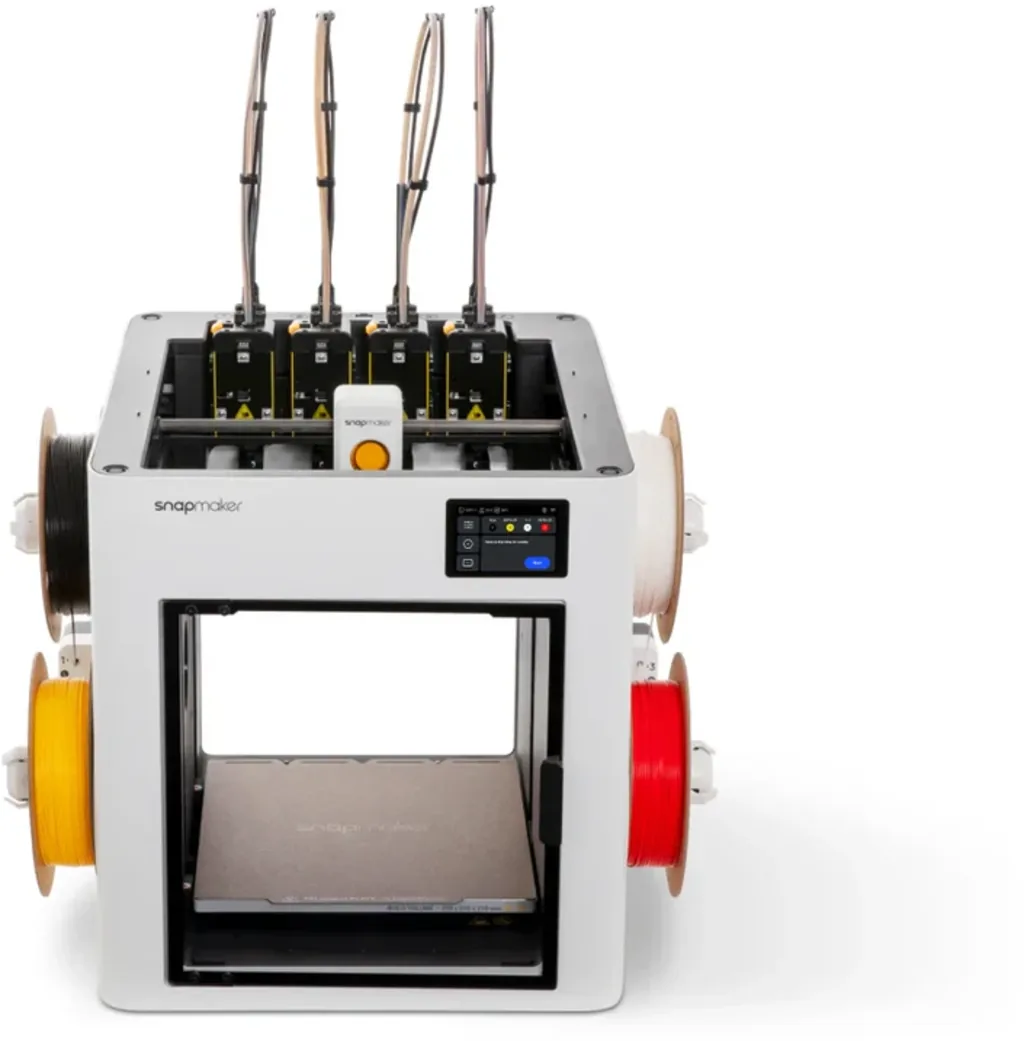
Toolchanging used to mean a Prusa XL and four thousand dollars. The U1 puts four heads, each preheated and loaded with its own filament, on a 270 mm CoreXY frame for a quarter of that, and swaps between them in about five seconds using kinematic couplings to re-register position. The reason this matters is waste: a filament changer purges the whole hot end every time the colour changes, and on a four-colour print the purge block can weigh more than the model. Swap the entire head and there is nothing to purge — Snapmaker quotes up to 80% less wasted filament. There is no enclosure and the bed stops at 100 °C, so this is a PLA and PETG machine; a top cover is sold separately for better temperature control. It is only sold with all four heads, which makes the comparison against combo pricing elsewhere unusually clean.
- Approx. price
- ~$999
- Build volume
- 19.7 L
- Per litre
- $51
- True multi-material price
- ~$999
Real speed ceiling
Not published
Snapmaker does not publish a volumetric flow rate for the U1, so its 500 mm/s claim cannot be checked against what the hotend can actually melt. We do not estimate one.
Best forMulti-colour printing where the purge waste of AMS-style changers has become the limiting cost.
Specifications
- Build volume
- 270 × 270 × 270 mm
- Volume
- 19.7 L
- Motion
- CoreXY
- Max speed
- 500 mm/s
- Acceleration
- 20,000 mm/s²
- Max flow
- Not published
- Hotend max temp
- 300 °C
- Bed max temp
- 100 °C
- Enclosure
- Open frame
- Extruder
- direct drive
- Auto level
- probe
Materials, control and build
- Multi-material
- toolchanger, 4 slots — included
- Firmware
- proprietary
- Cloud
- Optional
- Camera
- Yes
- Assembly
- Pre-assembled
Features
- Four toolheads, each preheated with its own filament
- Roughly five-second tool changes via kinematic couplings
- 270 mm cube CoreXY frame
- No purge block and no cross-contamination between materials
- Only sold complete with all four heads
What it does well
- Cheapest real toolchanger here by a wide margin — the function used to start at about $4,000
- Swapping the whole head means no purge tower at all, unlike every AMS and CFS machine
- No cross-contamination, so PLA and TPU or soluble supports can share a print cleanly
- Four heads are included rather than sold as a combo upgrade, so the sticker price is the real price
- Fast enough at 500 mm/s and 20,000 mm/s² to be a sensible single-colour printer too
Where it gives ground
- Open frame with a 100 °C bed — ABS, ASA and nylon are out unless you buy the separate top cover, and even then there is no heated chamber
- No published volumetric flow rate to check the speed claim
- Four moving toolheads are four times as much mechanism to go wrong; the platform is new and long-run reliability is unknown
- Stock nozzles are not hardened, so abrasive filament means replacing four of them
The points above are read off published specifications, not from owner reports.
What owners report
Drawn from owner discussions in 3D-printing communities, not from our own testing — this site has no test lab.
What owners like
- The price is the story — owners describe it as jumpstarting the category, bringing toolchanging to roughly a quarter of what it previously cost
- A long-time Prusa owner running two MK4S machines including one with a multi-material unit reports buying a U1 and loving it, which is a notable endorsement from an invested user of the alternative
- Runs Klipper and ships with a mainstream slicer rather than a proprietary one, which owners specifically noted approvingly
- All four toolheads are included, so the advertised price is the price of the multi-colour machine — unusual in this category
- Different nozzle sizes across toolheads is a capability owners are actively exploring
Common complaints
- It is not open-source, which owners flagged immediately as a difference from the toolchangers it is compared against
- The 270 mm build volume is smaller than the established toolchanger alternative, which matters if size is why you want multi-material
- Arrived through a crowdfunding and preorder process, and owners were openly weighing whether to cancel — the platform has little track record
- Open frame with no heated chamber, so the multi-material capability is limited to PLA and PETG in practice
- Competing approaches were announced around the same time, and owners were uncertain whether to buy or wait
The U1's significance in owner discussions is almost entirely about price. Toolchanging — four heads, each preheated with its own filament, swapped in seconds with no purge waste — previously started around four thousand dollars. Bringing that to roughly a quarter of the price is described by owners as jumpstarting the category, and the most striking endorsement comes from a long-standing Prusa owner running two MK4S machines and a multi-material unit, who bought one and reports loving it.
The reservations owners raised at the time are specific and fair. It is not open-source, which people noted immediately when comparing it against the alternatives. The build volume is smaller than the established toolchanger. It arrived via crowdfunding and preorder, and owners were openly debating whether to cancel their pledges, which is the appropriate posture toward a new platform with no service history.
The practical limit is materials rather than mechanism: an open frame with a 100 °C bed means this is a multi-colour PLA and PETG machine. If the reason you want several materials in one print is soluble supports on engineering parts, the enclosure is the missing piece.
Questions owners ask
+Why does toolchanging matter over an AMS-style changer?
A filament changer feeds several spools into one hot end, which must be flushed completely at every colour change — on a multi-colour print the purge can weigh more than the model. Swapping the whole toolhead means nothing to purge and no cross-contamination between materials, which also makes combinations like rigid plus flexible practical.
+Is the U1 open-source?
No, and owners flagged that immediately as the main philosophical difference from the toolchangers it gets compared against. It does run Klipper and ship with a mainstream slicer rather than a proprietary one, which owners noted as a partial consolation.
+U1 or a Prusa XL?
The XL has five heads rather than four, a much larger build volume, and a company with a long parts-support record behind it. The U1 costs a fraction as much. Owners in markets where two U1s cost about the same as one large Prusa describe that as genuinely hard to argue with. If build volume is the reason you want multi-material, the XL still wins.
+Can it use different nozzle sizes in one print?
Owners are actively exploring exactly this, which is one of the real advantages of swapping whole toolheads rather than filament — a coarse nozzle for infill and a fine one for detail in the same job. Worth researching current slicer support before buying for that specific reason.